
Blog
IRS Qualified Appraiser Requirements: How San Francisco Donors Should Vet an Art Appraiser
The IRS defines 'qualified appraiser' far more narrowly than most donors and estate executors assume. Here's how to confirm an art appraiser meets IRS qualified appraiser requirements before you commission a charitable-donation or estate report.
If you're donating artwork from a Bay Area collection, or you're an executor settling an estate that includes paintings, prints, or decorative objects, the IRS doesn't accept just any expert's opinion of value. It requires a qualified appraisal prepared by a qualified appraiser, and that second word carries specific legal weight. Before you commission a report for a charitable art donation or an estate filing, it's worth understanding exactly what the IRS checks, because a beautifully written valuation from the wrong person can still get your deduction denied.
What the IRS Means by a "Qualified Appraiser"
Under IRS qualified appraiser requirements, a person must satisfy three things at the moment the appraisal is signed: a competency standard, an independence standard, and a documentation standard. Meeting only one or two of these disqualifies the report, regardless of how well-known the appraiser's gallery or auction house name might be in San Francisco's art market.
The competency and independence rules come from the Treasury regulations governing qualified appraisals, and the documentation rule is enforced through Form 8283's instructions. None of these standards care about reputation alone. They care about demonstrated, property-specific competence and a lack of financial stake in the outcome.
The Two Paths to Meeting the Competency Standard
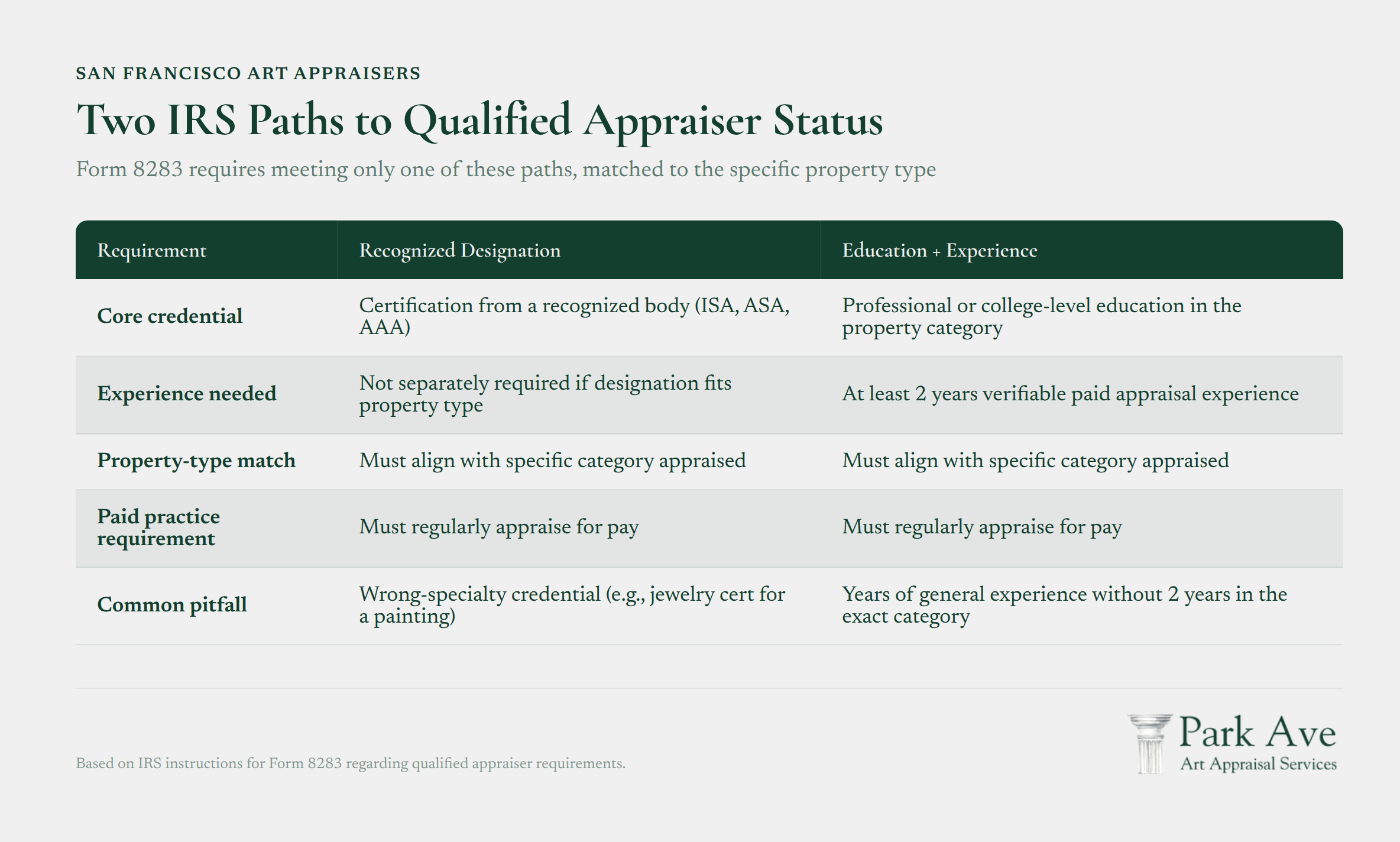
An appraiser can satisfy the IRS competency requirement in one of two ways, and only one path needs to apply:
- Recognized appraisal designation: The appraiser holds a credential from a generally recognized professional appraisal organization, such as the International Society of Appraisers (ISA), the American Society of Appraisers (ASA), or the Appraisers Association of America (AAA), that demonstrates competence in valuing the specific type of property involved.
- Education plus two years of experience: The appraiser has appropriate professional or college-level education in valuing that category of property, combined with at least two years of verifiable paid experience appraising that same type of property.
A designation in the wrong specialty doesn't satisfy either path. An appraiser certified to value jewelry isn't automatically qualified to value a mid-century painting, and the IRS instructions for Form 8283 are explicit that the credential or experience must match the property type being appraised. On top of either route, the individual must regularly prepare appraisals for pay; someone who appraises occasionally as a side activity, without a track record of paid engagements, generally does not meet the standard described in the Form 8283 instructions.
Pro tip: Ask directly how many years the appraiser has spent valuing your specific category, whether that's California estate silver, Bay Area contemporary art, or Asian antiques. "I've appraised art for 15 years" is not the same as two years of documented experience in the category at hand.
Who the IRS Excludes From Signing Your Appraisal
Even a perfectly credentialed appraiser can be disqualified by their relationship to the transaction. The excluded-individual rules, addressed in the Treasury regulations on qualified appraisals, rule out several categories of people from signing a qualified appraisal for your donation or estate:
- The donor or taxpayer: You cannot appraise your own donated property for your own deduction.
- The donee organization: The museum, nonprofit, or charity receiving the gift cannot sign the appraisal either, no matter how qualified its in-house staff.
- A party to the acquisition transaction: The dealer or auction house that sold you the piece, or that stands to resell it later, is generally excluded. This is the detail that trips up a lot of Bay Area collectors who assume a gallery's "complimentary appraisal" or an auction house estimate counts as an independent qualified appraisal. It usually doesn't.
- An appraiser who doesn't derive most of their income from unrelated parties: Someone who appraises mainly for the donor, donee, or a related party, rather than earning the majority of their appraisal income from independent work for other clients, fails the independence test.
- Anyone barred from practicing before the IRS under the relevant federal statute within the three years before the appraisal date.
Watch out: A gallery appraisal or auction house estimate can be useful for insurance or market research, but if that same business has a financial interest in buying, consigning, or reselling the piece, it generally will not qualify as an independent appraisal for a federal charitable deduction or estate filing.
The Declaration of Appraiser on Form 8283
A qualified appraiser must do more than hold the right credentials quietly in the background. For any donation reported in Section B, the appraiser is required to complete and sign Part IV, the Declaration of Appraiser, on the Form 8283 itself. That declaration states, in writing, that the appraiser's background, education, and experience qualify them to value the specific type of property being appraised, and it affirms the appraiser understands that a false or fraudulent overstatement of value can trigger civil penalties.
This is also where USPAP compliance matters. A report that is prepared in accordance with USPAP, the Uniform Standards of Professional Appraisal Practice maintained by The Appraisal Foundation, gives your donee, the IRS, and your own tax preparer a consistent, defensible structure to review: the valuation method used, the market data relied on, and the reasoning behind the final number. A one-page letter stating a dollar figure, with no methodology attached, rarely meets this bar.
Dollar Thresholds That Raise the Stakes for Art
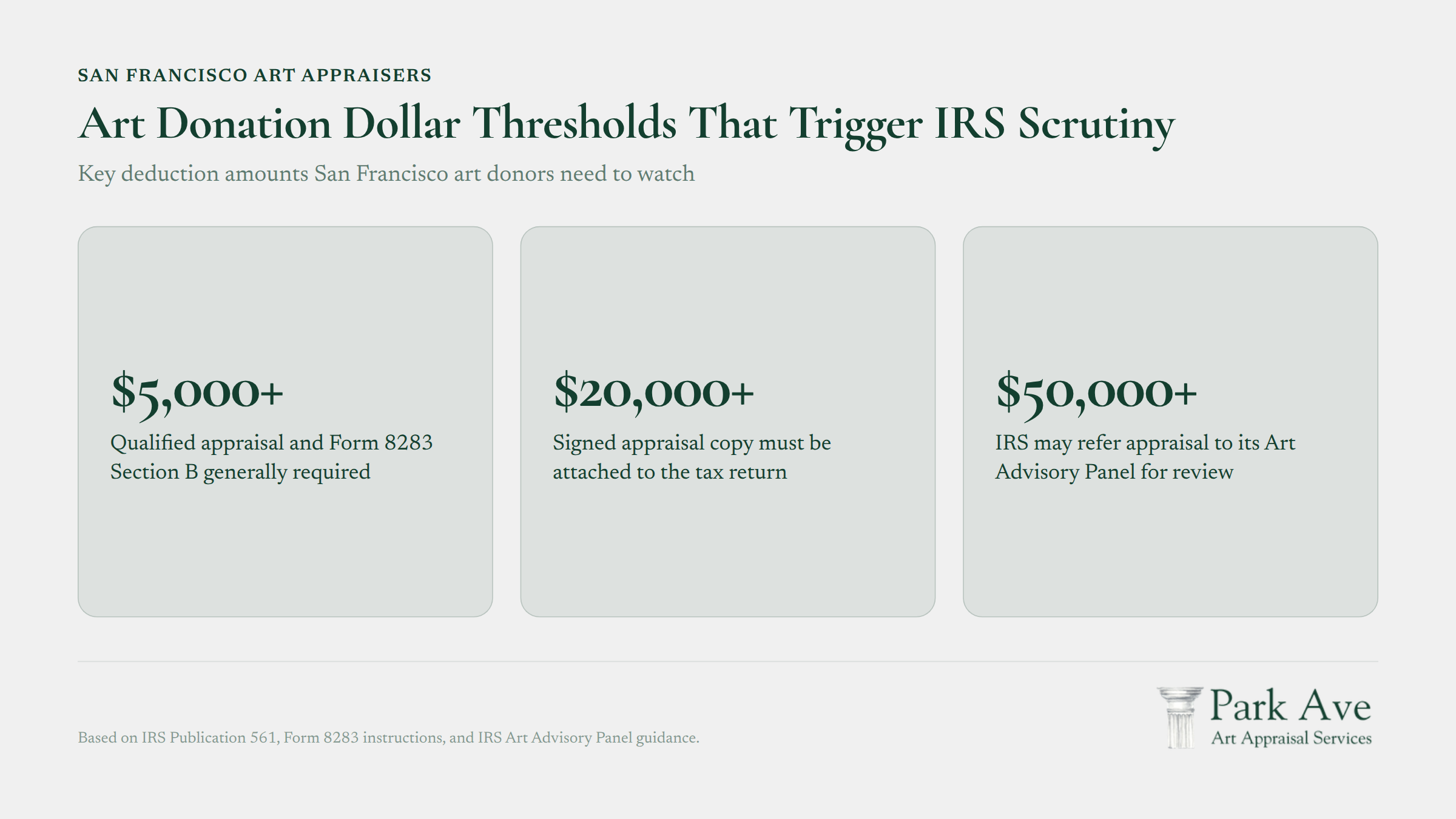
Art donations carry extra scrutiny because values can be subjective and the dollar amounts involved tend to be larger than the typical household-goods donation. Three thresholds matter most:
| Claimed deduction | What's required |
|---|---|
| Over $5,000 | A qualified appraisal and Form 8283, Section B, are generally required for the item or group of similar items, per IRS Publication 561. |
| $20,000 or more for an item of art | A complete copy of the signed appraisal must generally be attached to the return, not just referenced, per the Form 8283 instructions. |
| $50,000 or more | The IRS may refer the appraisal to its Art Advisory Panel for an independent review of the claimed value, separate from any audit. |
That last threshold is specific to art and a handful of other hard-to-value categories. It means a San Francisco donor giving a $60,000 painting to a local museum should expect their appraiser's methodology, not just their conclusion, to hold up to review by specialists who evaluate art valuations for a living.
Prohibited Fee Arrangements
A qualified appraiser's fee cannot be based on a percentage of the appraised value, nor can it be contingent on the size of the deduction the donor ultimately claims. This rule exists for an obvious reason: a percentage-based fee gives the appraiser a direct financial incentive to inflate the value. If an appraiser proposes charging you a cut of the appraised amount instead of a flat or hourly fee, that arrangement alone can disqualify the resulting report, independent of the appraiser's credentials or experience.
How to Vet an Art Appraiser in San Francisco Before You Commission a Report
Before engaging anyone to value a donated painting, an inherited collection, or an estate's decorative art, run through a short verification process rather than relying on a website or a referral alone:
- Ask for credentials specific to the property type. Request to see the appraiser's ISA, ASA, or AAA designation, and confirm it covers the exact category: fine art, Asian works, prints, decorative objects, or whatever you're having valued.
- Request a sample redacted report. A qualified appraiser should be able to show a report that documents methodology, comparable sales, and a reasoned value conclusion, not just a one-line estimate.
- Confirm they are not a dealer or auction house with a resale interest. If the person valuing your piece also buys, sells, or consigns similar work, ask directly whether they have any financial interest in the property or a related transaction.
- Confirm USPAP compliance in writing. Ask whether the report will be prepared in accordance with USPAP and whether the appraiser can explain their valuation method before you sign an engagement letter.
- Confirm the fee is flat or hourly, never a percentage of value. This single question eliminates a surprising number of disqualifying arrangements before they start.
- Confirm willingness to sign Form 8283, Part IV. An appraiser who hesitates to sign the Declaration of Appraiser, or who hasn't done it before, may not have the documented track record the IRS expects.
Getting the Documentation Right the First Time
For Bay Area collectors and estate executors, the cost of skipping this vetting process isn't just an audit risk. It's the possibility that a deduction claimed in good faith gets disallowed months or years later, after the donation has already been made and the tax return already filed. Confirming an appraiser's qualification path, independence, and fee structure before the engagement begins is far easier than untangling a disqualified appraisal afterward.
This article is provided for general informational purposes only and does not constitute legal, tax, or financial advice. Readers should consult a qualified attorney or CPA regarding their specific circumstances.