
Blog
IRS Form 8283 for a San Francisco Art Donation: a Line-by-Line Guide
Donating art worth more than $5,000 to a Bay Area museum or nonprofit means filing IRS Form 8283 correctly. This line-by-line guide walks San Francisco donors through Section A versus Section B, who signs what, and the $20,000 attachment rule.
A San Francisco collector who donates artwork and claims a deduction above $500 has to attach IRS Form 8283 to the federal return. Once the claimed value for a single piece, or a group of similar pieces, passes $5,000, the form gets more demanding: a qualified appraisal, a signed appraiser declaration, and an acknowledgment from the receiving institution all have to line up on the same document. This guide walks through the form section by section, so a Bay Area donor and their CPA know exactly what belongs where before anything gets mailed to the IRS.
If you haven't yet worked out which Bay Area nonprofit or museum should receive the gift, or what documentation the appraisal itself needs to contain, our guide to donating art in San Francisco covers that ground first. This piece picks up once you know the donation is happening and you need to get the paperwork right.
Who Must File Form 8283 for an Art Donation
Form 8283 is required whenever your total noncash charitable contributions for the year exceed $500, and it's required specifically for art once the claimed deduction for an item, or a group of similar items, exceeds that threshold, according to the IRS instructions for Form 8283. Below $500, most donors don't need the form at all.
The thresholds that matter for art donations are:
- $500: the point at which Form 8283 generally becomes required for any noncash gift.
- $5,000: the point at which a single artwork, or a group of similar items, moves into Section B and requires a qualified appraisal.
- $20,000: the point at which a complete, signed copy of the appraisal must be physically attached to the return.
- $500,000: a broader rule under which any noncash property deduction, art included, requires the qualified appraisal to be attached regardless of category.
These dollar figures track the claimed deduction, not the artist's original sale price or what a similar piece fetched at auction. A donor who believes a painting is worth $4,000 but later has it appraised at $6,200 has crossed into Section B territory even though the original estimate looked modest.
Section A vs Section B: Which One Applies to Your Donation
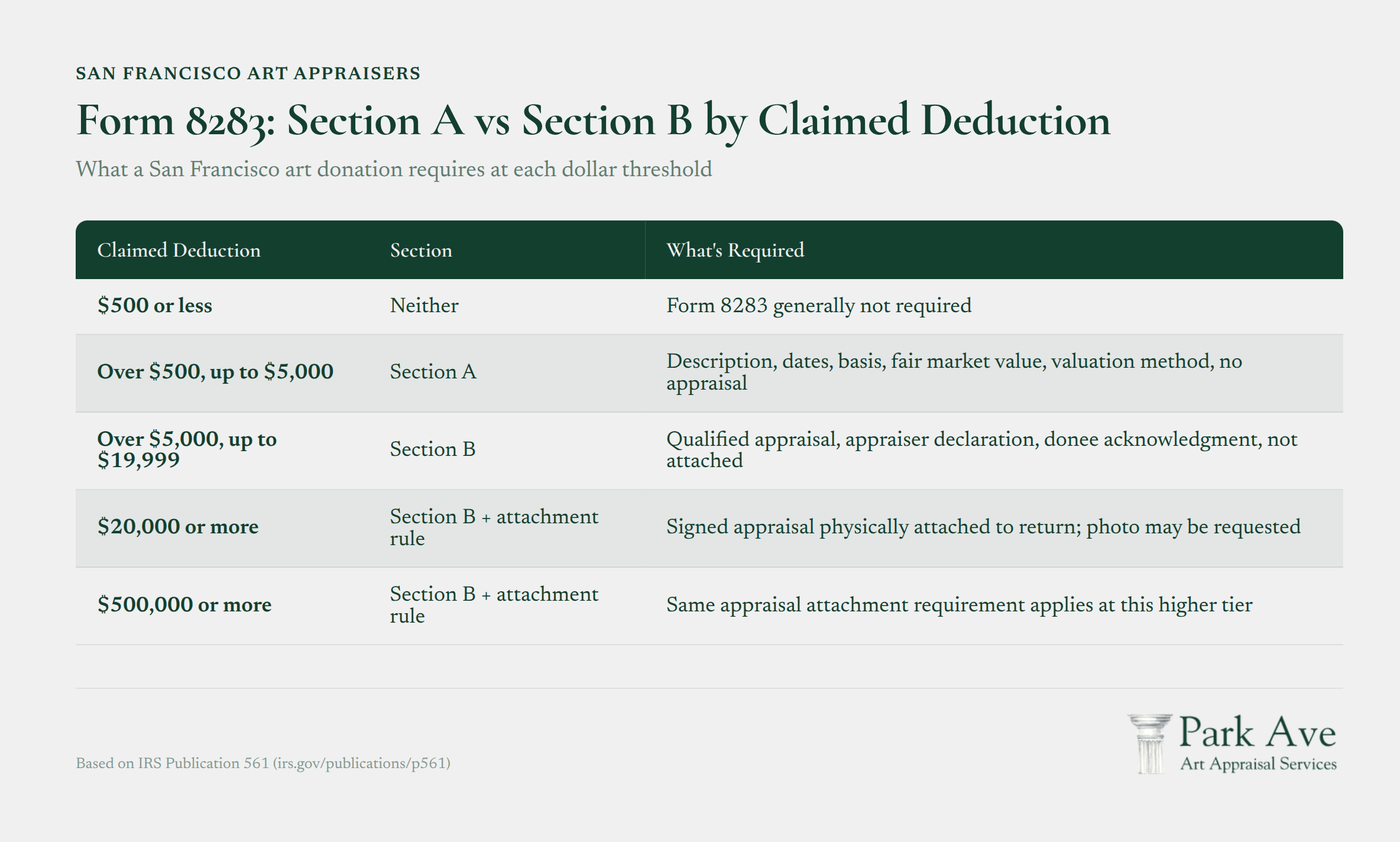
The form splits into two sections, and the dividing line is the $5,000 claimed deduction for the art.
| Claimed deduction | Section | What's required |
|---|---|---|
| $500 or less | Neither | Form 8283 generally not required. |
| Over $500, up to $5,000 | Section A | Description, dates, basis, fair market value, and valuation method. No appraisal required. |
| Over $5,000 | Section B | Full qualified appraisal, appraiser declaration, and donee acknowledgment. |
| $20,000 or more (art) | Section B, plus attachment rule | Complete signed appraisal attached to the return; photograph may be requested. |
A donor giving a $3,000 print to a Bay Area arts nonprofit stays in Section A and never needs an appraiser's signature on the form. A donor giving a painting appraised at $18,000 moves into Section B, needs the qualified appraisal prepared, and needs the receiving institution to sign off, but does not attach the full appraisal document itself. Only once the figure clears $20,000 does the complete appraisal get physically attached, per Publication 561.
What Section B Part I Requires for an Art Donation
For each piece of art reported in Section B, Part I of Form 8283 asks for:
- Description of the donated property. For art, this means enough detail to distinguish the work from any other: artist, title, medium, dimensions, and edition or serial number if one exists.
- Date of contribution. This is the date the work actually transferred to the donee organization, not the date the appraisal was signed.
- How acquired and date acquired. Purchase, gift, or inheritance, along with the date (or "various" where that applies).
- Donor's cost or other basis. This is the donor's tax basis in the artwork, which is a different number than the fair market value being claimed.
- Fair market value. The amount being claimed as the deduction, which has to tie back to the appraiser's conclusion.
- Method used to determine fair market value. A brief description of the valuation approach, such as comparable auction sales or dealer evidence.
The instructions generally call for a separate Form 8283 for each item, unless the pieces qualify as a group of similar items contributed to the same organization in the same tax year, as described in the Form 8283 instructions.
The $20,000 Rule and the Photograph Request
Once the claimed deduction for art reaches $20,000, a complete, signed copy of the qualified appraisal has to be attached to the federal return, not just summarized on Form 8283. Below that figure, the appraisal is kept in the donor's records but doesn't need to travel with the filing, though the IRS Art Appraisal Services group recommends attaching it anyway to reduce the odds of an unnecessary audit inquiry.
The IRS can also request a photograph of the piece, and for a work valued at $20,000 or more, the guidance calls for an image sized and detailed enough to fully show the object, ideally a high-resolution digital photograph. We build this into our process for every San Francisco art appraisal that crosses the $20,000 line, so the file is ready if it's ever requested.
Pro tip: Keep a dated, high-resolution photo of the piece from the same session as the physical inspection. If the IRS requests an image months or years later, you want one that clearly matches the appraisal's description.
Who Signs Each Part of Section B
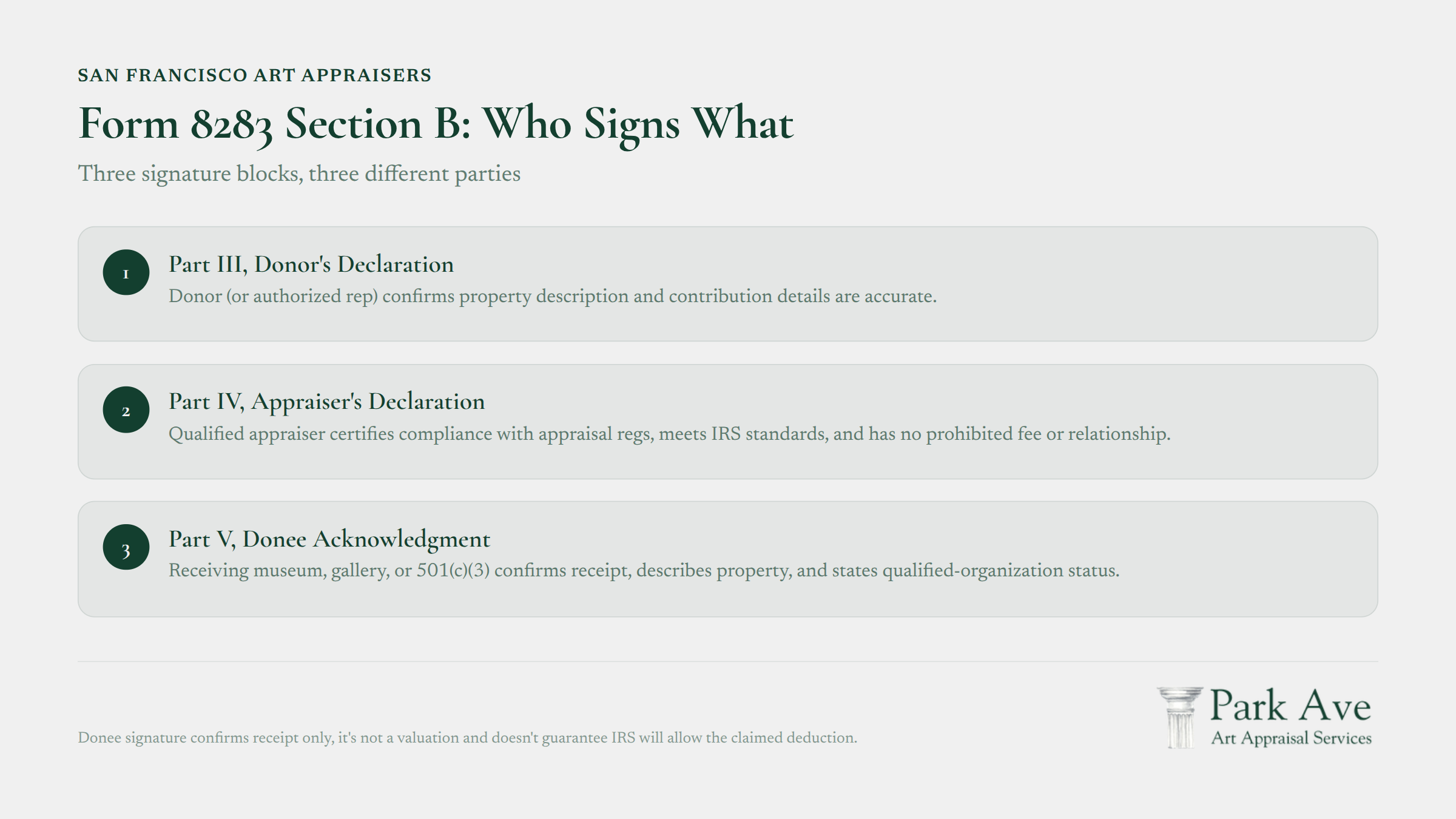
Section B has three distinct signature blocks, and each one belongs to a different party.
- Part III, donor's declaration. The donor (or their authorized representative) signs, confirming the property description and contribution details are accurate.
- Part IV, appraiser's declaration. The qualified appraiser signs and dates this section, certifying that the appraisal was prepared in accordance with the regulatory requirements for qualified appraisals, that the appraiser meets the IRS's qualified-appraiser standards, and that the appraiser isn't barred by a prohibited relationship or a prohibited fee arrangement (such as a fee calculated as a percentage of the appraised value).
- Part V, donee acknowledgment. The receiving institution, whether that's a Bay Area museum, university gallery, or 501(c)(3) nonprofit, signs to confirm it received the property, describes it, and states whether it's a qualified organization under the tax code.
A donee's signature on Part V confirms receipt; it isn't an independent valuation and doesn't guarantee the IRS will allow the deduction as claimed.
Sequencing the Signatures
There's no required order for Parts III, IV, and V. The donor, the appraiser, and the donee can sign in whatever sequence is logistically easiest, as long as all three end up on the same completed document before the return is filed. In practice, most San Francisco donations follow a predictable path:
- Appraiser completes Part I and Part IV. Our team prepares the qualified appraisal, fills in the property description and valuation details, and signs the appraiser's declaration.
- Donor reviews and signs Part III. The donor, often working alongside a CPA, confirms the contribution information is accurate.
- Donee signs Part V. The receiving museum or nonprofit confirms it received the work and describes its intended use.
Because the receiving institution's development or registrar office often needs its own internal review time, it's worth sending the completed Parts I through IV to the donee as early as possible, rather than waiting until the tax filing deadline is close.
The December 2025 Revision: What Actually Changed
The IRS periodically updates Form 8283's layout without changing the underlying valuation or appraisal rules. The December 2025 revision falls into that category: it refined how entities identify themselves on the form and added a checkbox addressing family pass-through entity donors. Neither change altered the dollar thresholds, the qualified-appraisal requirements, or who has to sign which part of the form. A donor who completed Form 8283 correctly under an earlier revision will recognize the same structure, the same Section A and B thresholds, and the same signature blocks on the current version.
How We Support the Form 8283 Filing
Our appraisers prepare the qualified appraisal itself and complete the appraiser's declaration in Part IV, with the valuation built around fair market value as of the contribution date and documented according to generally accepted appraisal standards, including USPAP. The donor and their CPA remain responsible for Part I's taxpayer-facing details and the Part III signature, and the receiving institution completes Part V once the gift is received. Keeping those three roles distinct, rather than blending them, is exactly what the IRS structure is designed to enforce.
If you're planning an art donation to a Bay Area institution and need the qualified appraisal that Section B requires, you can request an art appraisal and we'll scope the work around your donation timeline and the receiving organization's requirements.
This article is provided for general informational purposes only and does not constitute legal, tax, or financial advice. Readers should consult a qualified attorney or CPA regarding their specific circumstances.