
Blog
Fair Market Value vs Replacement Value vs Liquidation Value: Which Art Appraisal Standard do you Need?
An art appraisal isn't one standard answer; fair market value, replacement value, and liquidation value can produce three different numbers for the same painting. Here's which standard applies to IRS donations, insurance scheduling, and forced sales, and why asking for the wrong one can derail your filing or your claim.
Collectors call and ask for "an appraisal" of a painting, a print, or a sculpture, assuming there's a single correct number waiting to be found. There isn't. The same work of art can carry three legitimate, defensible values depending on why the appraisal exists: what the IRS will recognize for a donation deduction, what an insurer will pay to replace the piece after a fire, and what a court will accept in a divorce settlement are rarely the same figure.
That confusion causes real problems. A donor who hands an insurance appraisal to their accountant for a charitable deduction will likely see the deduction challenged, because insurance values and tax values are built on different assumptions. Understanding the three standards before you request an appraisal saves time, money, and in some cases an IRS dispute.
The short answer: fair market value governs IRS donation and estate filings, replacement value governs insurance coverage, and liquidation value governs divorce, lending, bankruptcy, or any situation requiring a fast sale. Each standard asks a different question about the same object, and each produces a different number. Our San Francisco art appraisers scope every engagement around the specific standard a client's situation requires, because using the wrong one can undermine the entire purpose of the report.
Fair Market Value: the IRS, Estate, and Donation Standard
Fair market value (FMV) is the price a work of art would bring in a transaction between a willing buyer and a willing seller, neither one under any compulsion to act, and both reasonably informed about the relevant facts. This is the federal definition that governs charitable contribution deductions, and the IRS Revenue Procedure discussing the willing-buyer, willing-seller standard makes clear that this is a hypothetical market transaction, not an actual sale that has to occur.
A few features make FMV distinct from the other two standards:
- Neither party is forced. The buyer doesn't need the painting and the seller doesn't need to unload it. This removes both the urgency premium of a forced sale and the convenience premium of a retail purchase.
- The market is the one most common to the property, not necessarily a retail gallery. For a painting that typically trades at auction among collectors, the auction market, not a retail gallery asking price, is usually the relevant evidence.
- It applies to both donations and estates. A donor claiming a deduction for art given to a museum needs FMV as of the date of the gift. An estate reporting art on a federal return needs FMV as of the date of death (or an alternate valuation date), under the same general concept.
For estate tax purposes, the regulations require a formal appraisal once personal property, including art, crosses a relatively modest threshold, generally $3,000 per item or collection, rather than leaving every modest object to informal valuation. Below that line, an executor can often rely on other documentation, but art collections frequently exceed it item by item.
For donations, the dollar threshold that triggers the requirement for a qualified appraisal is higher: a noncash charitable contribution of art valued above $5,000 generally requires a qualified appraisal, and contributions above $20,000 generally require the complete appraisal to be attached to the return. The appraisal itself must be prepared, signed, and dated within a defined window around the contribution date, as set out in the Treasury regulation governing qualified appraisals. The IRS also recognizes several acceptable valuation approaches for art, including market-data comparisons and, less commonly for unique works, cost-based methods, which IRS Publication 561 on determining the value of donated property outlines in more detail.
If you're preparing a donation, our guide to IRS Form 8283 for a San Francisco art donation walks through the filing mechanics once the FMV appraisal is in hand.
Replacement Value: the Insurance Standard
Replacement value answers a completely different question: what would it cost to replace this specific piece with a comparable item, in the marketplace where the owner would most likely shop, within a reasonable amount of time? It is not what the owner could sell the piece for. It is what they would have to spend to get an equivalent one back.
That distinction matters because replacement value is typically built around the retail market, not the auction or wholesale market that often drives fair market value. If a collector buys through galleries and dealers rather than at auction, the appraiser should price the replacement at that retail level, because that's genuinely where the collector would go to replace the loss.
For appreciating fine art, this often pushes replacement value higher than fair market value, sometimes substantially higher. A few reasons why:
- Retail asking prices run above auction hammer prices for comparable work, since galleries carry overhead and offer services like authentication support that auction houses don't.
- A truly equivalent replacement may be scarce, especially for a deceased or historically significant artist, which pushes the replacement cost up further.
- The figure can include costs FMV ignores, such as dealer commissions, shipping, framing, conservation, or import duties, depending on how the insurance policy defines the benefit.
Because "replacement value" alone is an incomplete instruction, a sound insurance appraisal states exactly which replacement premise it uses: retail replacement cost, replacement cost new, or another policy-specific measure. Our guide on how to value art for insurance covers what a defensible insurance schedule needs to include beyond the number itself.
Pro tip: Tell your appraiser the intended use of the report before the engagement begins, not after the draft arrives. A single sentence ("this is for an insurance schedule" or "this is for a charitable donation") determines the entire valuation premise, the market level examined, and often the comparable sales selected.
Liquidation Value: the Divorce, Lending, and Forced-Sale Standard
Liquidation value estimates what a piece would actually bring if it had to be sold under defined, often compressed, conditions rather than through the ordinary, patient market that fair market value assumes. It splits into two distinct sub-standards:
- Orderly liquidation value assumes a reasonable marketing period, perhaps several months, with an organized sale process, but still under some pressure to sell. Think of an estate that needs to liquidate within a set timeframe to close probate, or a business winding down on a schedule.
- Forced liquidation value assumes an immediate or severely compressed sale, often through emergency auction, with little to no marketing period. Think of a creditor seizing collateral or a court-ordered sale with a hard deadline.
Both figures generally sit below fair market value, and forced liquidation value typically sits below orderly liquidation value, because compulsion and time pressure work against the seller. A painting that might fetch its full fair market value with a 12-month marketing campaign may bring considerably less if it has to move within 30 days.
Liquidation value tends to come up in:
- Divorce and dissolution proceedings where a court orders a quick division of marital property
- Bankruptcy and insolvency matters where a trustee needs realistic recovery figures
- Secured lending situations where a lender needs to know worst-case collateral recovery
- Estate settlements under a hard deadline to pay creditors or distribute assets
It is generally the wrong standard for an insurance schedule or a charitable donation unless a court order or lender specifically calls for it, since neither of those contexts assumes a distressed sale.
Comparing the Three Standards Side by Side
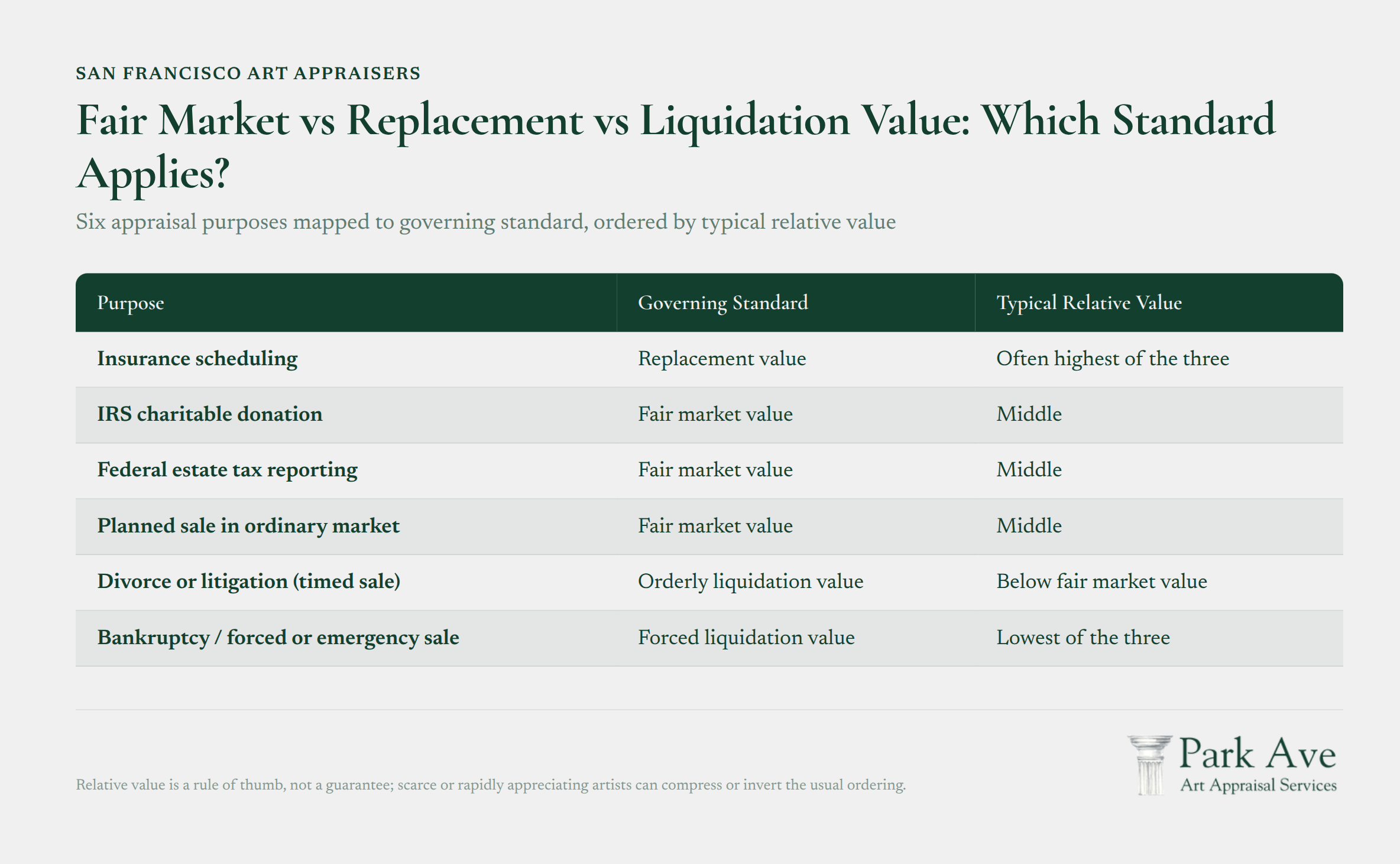
The table below summarizes which standard typically governs which purpose, along with the general relationship between the three values. Relative value level is a useful rule of thumb, not a guarantee: a scarce or rapidly appreciating artist can sometimes compress or even invert the usual ordering.
| Purpose | Governing standard | Typical relative value |
|---|---|---|
| Insurance scheduling | Replacement value | Often the highest of the three |
| IRS charitable donation | Fair market value | Middle |
| Federal estate tax reporting | Fair market value | Middle |
| Planned sale in the ordinary market | Fair market value | Middle |
| Divorce or litigation requiring a timed sale | Orderly liquidation value | Below fair market value |
| Bankruptcy, forced lending disposition, emergency sale | Forced liquidation value | Lowest of the three |
Why Naming the Intended Use Matters Before the Appraisal Begins
An appraisal report built on the wrong value standard doesn't just produce an inconvenient number, it can fail entirely for its intended purpose. An insurance replacement figure submitted with a donation return invites an IRS challenge, because the agency is looking for fair market value, not retail replacement cost. A fair market value report submitted to a divorce court expecting liquidation value may overstate what a spouse could realistically recover from a fast sale.
Watch out: Requesting "an appraisal" without specifying the intended use is the single most common reason a report gets rejected or has to be redone. The appraiser cannot guess whether the number needs to satisfy the IRS, an insurer, or a court; that has to come from the client.
USPAP, the standard our appraisers follow on every engagement, requires that any opinion of value be qualified by its premise, meaning the report must state outright whether it concludes fair market value, replacement value, liquidation value, or some other defined basis. That requirement exists precisely because the same object can carry different, equally legitimate values depending on the question being asked.
When an estate is involved, the value standard question often overlaps with other decisions, like whether the art received a stepped-up basis. Our guide to inherited art and stepped-up basis in California covers how that interacts with fair market value reporting for heirs.
Getting the Right Standard From the Start
Fair market value, replacement value, and liquidation value aren't interchangeable labels for "what is this worth." They're answers to three different questions, built on three different sets of assumptions about who is buying, how much time they have, and why the sale is happening at all. Knowing which question your situation is actually asking, before the appraiser starts researching comparables, is what keeps the resulting report useful for its intended purpose.
If you're not sure which standard your situation calls for, start by naming the use: a donation deduction, an estate filing, an insurance policy, or a court proceeding. From there, our team can scope the engagement to the correct value premise and the market evidence that actually supports it. Reach out to request an art appraisal and we'll confirm the right standard before any work begins.
This article is provided for general informational purposes only and does not constitute legal, tax, or financial advice. Readers should consult a qualified attorney or CPA regarding their specific circumstances.