
Blog
Art Appraisal in a California Divorce: How Community Property Divides an Art Collection in San Francisco
An art appraisal in a California divorce turns on community property rules, the valuation date, and a defensible fair market value. This guide shows how San Francisco family courts approach an art collection and what the appraisal must establish to divide or buy out a spouse's interest.
Art is one of the harder assets to handle in a California divorce. Each piece can have a different history, a different owner on paper, and a value that moves with the market. A sound art appraisal in a California divorce gives the court and both attorneys a neutral number for each work, tied to a specific date and a stated value standard. This guide explains how community property and separate property rules apply to art, why the valuation date can change the numbers, and what our art appraisal service puts in a report prepared for a San Francisco family law matter.
One point up front: California statewide family law applies in San Francisco, and San Francisco Superior Court family law judges apply it. There is no separate art rulebook for the city. The same Family Code sections govern a Bay Area collection as a Sacramento or San Diego one.
Who Decides What Is Community or Separate: The Court, Not the Appraiser
The appraiser values the art; the court and the attorneys decide whether each work is community or separate property. That division of labor matters. Our appraisers do not characterize ownership, trace funds, or decide what is excluded from the marital estate, because the law dictates that.
What we do is give both sides a reliable value for every item, so characterization and division can happen on solid numbers. In dissolution work the overriding goal is fair compensation to both parties. A good appraisal serves that goal, not either spouse's position.
How California Classifies Art: Community Property vs. Separate Property
Property acquired during marriage while domiciled in California is presumed to be community property under Family Code 760. Family Code 770 defines separate property as property owned before marriage, property acquired during marriage by gift, bequest, devise, or descent, and the rents, issues, and profits of separate property. Applied to art, that produces several common patterns.
- Bought before marriage: Usually separate property, with the appraisal question being what it is worth on the valuation date.
- Bought during marriage with earnings: Presumptively community property, regardless of whose name is on the invoice.
- Gifted or inherited: Generally separate property if it came to one spouse alone by gift or inheritance.
- Appreciation of premarital art: The work itself stays separate in the typical case, but disputes arise when community funds or effort paid for restoration, framing, storage, or other improvements.
- Commingled or traced purchases: A work bought with a mix of separate and community money raises tracing questions.
Tracing and transmutation questions (whether spouses changed a work's character by agreement or by how they handled it) belong to your family law attorney. We do not answer them. What we can do is work from the purchase records, gift documents, and estate inventories you and your attorney provide, and record each work's documented history accurately in the report.
Family Code 2550 then directs the court to divide the community estate equally, absent a written agreement, an oral stipulation in open court, or a statutory exception. Equal means equal in value, not an equal number of paintings.
Scenario Table: How Different Art Situations Are Typically Approached
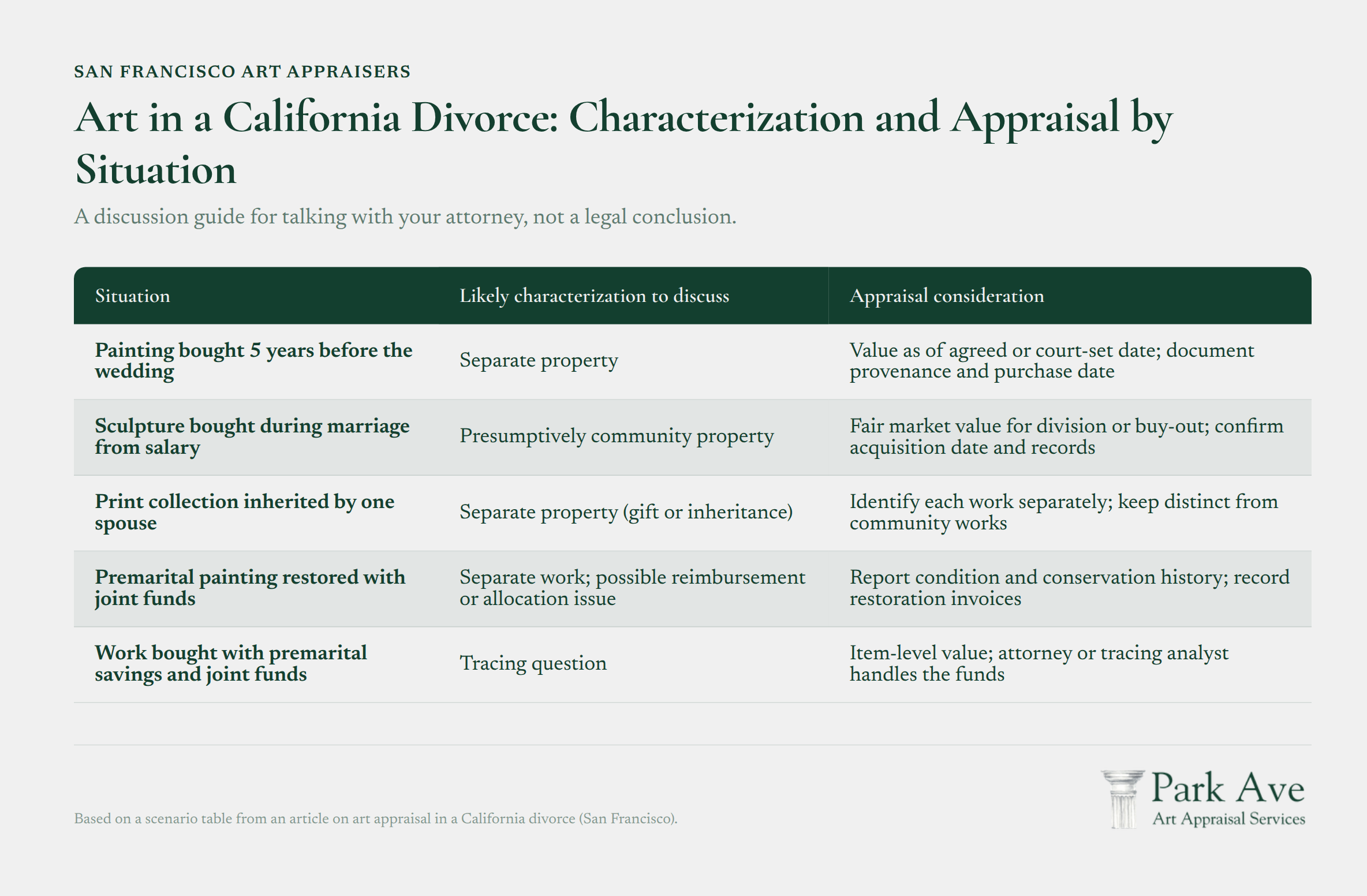
The table below shows common fact patterns, the characterization an attorney would likely discuss, and what the appraisal has to account for. It is a discussion guide, not a legal conclusion.
| Situation | Likely characterization to discuss with your attorney | Appraisal consideration |
|---|---|---|
| Painting bought 5 years before the wedding | Separate property | Value as of the agreed or court-set date; document provenance and purchase date |
| Sculpture bought during marriage from salary | Presumptively community property | Fair market value for division or buy-out; confirm acquisition date and records |
| Print collection inherited by one spouse | Separate property (gift or inheritance) | Identify each work separately; keep it distinct from community works |
| Premarital painting restored with joint funds | Separate work, possible reimbursement or allocation issue | Report condition and conservation history; record restoration invoices |
| Work bought with a mix of premarital savings and joint account funds | Tracing question | Item-level value; attorney or tracing analyst handles the funds |
Why the Valuation Date Matters for Art
Family Code 2552 sets the default: community assets are valued as near as practicable to the time of trial. On 30 days' notice and good cause, the court may instead use an earlier date after separation but before trial. The parties can also agree on a valuation date. Because art prices respond to auction results, artist reputation, and collector demand, the date you pick can change the numbers meaningfully.
Example: A hypothetical Bay Area landscape is worth $300,000 on the date of separation. By trial, a museum retrospective and strong auction results push its fair market value to $360,000. On the trial-date default, each spouse's half is $180,000. Using the separation date instead, each half is $150,000, a $30,000 difference per spouse on one painting. The reverse can also happen if the market softens.
Watch out: An appraisal that reports "current value" without an effective date is hard to use. The report should state the effective date, and if your attorney expects a dispute over the date, our appraisers can provide values as of more than 1 date when asked.
Why a USPAP-Compliant Fair Market Value Appraisal Is Needed to Divide or Buy Out
Splitting a collection fairly requires a documented number for each work. Family Code 2601 lets the court assign an asset to one spouse and order an equalizing payment so the overall division stays equal. That is the legal basis for a buy-out of a spouse's interest in a collection, and the size of the payment depends entirely on the appraised value.
Example: A collection has a community value of $400,000. Spouse A wants to keep every work. Each spouse's equal share is $200,000, so Spouse A would make a $200,000 equalizing payment to Spouse B, in cash or through offsetting assets such as retirement funds or other property. If the appraisal were off by 15 percent, that payment could be off by $30,000 in either direction.
Family Code 2640 can add a layer. A spouse who contributed traceable separate property toward acquiring community property may be entitled to reimbursement. That reimbursement carries no interest or appreciation, is capped at the net value, and can be waived in writing. Whether it applies is a legal question; the appraisal supplies the value that sets the cap.
Our reports are prepared in accordance with USPAP, the Uniform Standards of Professional Appraisal Practice published by The Appraisal Foundation. Our appraisers hold credentials with organizations such as the ASA, ISA, and AAA. For more on what that standard means in practice, see our explanation of what makes an art appraisal legally defensible.
Confirm the Value Standard First
Before valuing anything, the appraiser must confirm with the client or attorney which value standard applies and the effective date. In divorce practice the options include fair market value, net value (expected sale proceeds minus selling costs and liens), and value in use. These are not interchangeable.
Insurance replacement value, for example, can far exceed what a work would bring in an ordinary sale. If you are unsure which standard your case calls for, our comparison of fair market value, replacement value, and liquidation value explains the differences. Your attorney makes the final call, and we follow it.
What the Appraisal Report Should Include for a San Francisco Family Law Matter
A divorce report must let opposing counsel and the judge test the identification, assumptions, and conclusions. Our reports for dissolution matters include the following elements:
- Intended use and intended users: Stated plainly as a marital dissolution matter, so the report is not repurposed for something else.
- Value definition: Fair market value or the standard your attorney specifies, with the market assumed (auction, dealer retail, or private sale).
- Effective valuation date: Tied to the trial date, an agreed date, or a court-ordered earlier date.
- Item-by-item list: Artist, title, date, medium, dimensions, signatures, and edition details where applicable.
- Provenance and condition: Ownership history, exhibition and publication history, restoration, and condition notes.
- Comparable sales and reasoning: The market data used and why those comparables fit each work.
- Assumptions and limiting conditions: Including any attribution questions we could not resolve.
The Judicial Council's FL-142 Schedule of Assets and Debts asks parties to list known assets, including art and collections, and to state whether each is community or separate. The report's item list gives you a clean basis for completing that form, but listing and characterizing assets remains with you and your attorney.
The Neutral or Joint Appraiser Option
Spouses often disagree about art values, and 2 competing appraisals can add cost and conflict. Many couples choose a single neutral appraiser engaged jointly, or agree through counsel on whom to use. A jointly engaged appraiser owes the report to the engagement as a whole, with no loyalty to either side, which keeps the focus on fair compensation to both parties.
Pro tip: Agree on the appraiser, value standard, and effective date in writing before work begins. It prevents a later argument over the report's foundations.
How to Prepare Your Art Collection for a Divorce Appraisal
Good records make a better appraisal and a more efficient engagement. Gather these items before you start:
- Collect Acquisition Records
- Invoices, canceled checks, auction settlement statements, and gallery correspondence show when and how each work was bought.
- Pull Gift and Inheritance Documents
- Estate inventories, letters, and trust records help your attorney sort separate from community works.
- Photograph Every Work
- Take front, back, signature, frame, and any damage, with dimensions noted.
- Locate Prior Appraisals and Insurance Schedules
- Treat them as background only, since they may use a different value standard or date.
- Gather Conservation and Storage Records
- Restoration invoices matter for condition and for any improvement question your attorney raises.
- Confirm the Standard and Date With Your Attorney
- Tell us the value standard and effective date so we can scope the report correctly.
Art appraisals are done online by default: you send photographs and documents, and our team completes the valuation remotely. On-site inspection is available for larger or more complex collections, but most engagements do not need it.
What a Divorce Art Appraisal Costs
Engagements are quoted as a fixed fee after we scope the collection, before work begins, and never billed hourly. The fee depends on the number of works, the quality and completeness of your records, the intended use, and the depth of analysis required. It does not depend on how valuable the art turns out to be.
Get the Value Right Before You Divide
California law presumes that art bought during marriage is community property, treats premarital and inherited works as separate, and divides the community estate equally in value. The valuation date can shift the numbers, and a buy-out is only as fair as the appraisal behind it. Your attorney decides how each work is characterized; our job is to give both sides a USPAP-compliant, well-documented value. To start, send us a description of the collection through our request form and we will scope a fixed fee.
This article is provided for general informational purposes only and does not constitute legal, tax, or financial advice. Readers should consult a qualified attorney or CPA regarding their specific circumstances.