
Blog
USPAP Compliance Explained: What Makes a San Francisco Art Appraisal Legally Defensible
A USPAP compliant art appraisal is what stands up to IRS review, probate court scrutiny, and insurer pushback in the Bay Area. Here's exactly what the standard requires inside the report itself, and why it matters for your estate, donation, or claim.
When a Bay Area collector's estate goes through probate, when a donor claims a deduction for a gift to SFMOMA or a local museum, or when a divorcing couple argues over a painting's value, the appraisal report itself gets tested. Not just the number at the bottom, but the reasoning behind it. A USPAP compliant art appraisal is the standard that the IRS, courts, and insurers all point to when they ask whether a valuation can be trusted. This guide walks through what USPAP actually requires inside the report, and where the IRS and the courts layer their own rules on top of it.
What USPAP Compliance Actually Means for an Art Appraisal
USPAP, the Uniform Standards of Professional Appraisal Practice, is the ethical and performance standard that governs how appraisers develop and report their conclusions. It is published by The Appraisal Foundation and updated on a recurring cycle. For personal property, which includes fine art, decorative arts, and collectibles, the relevant provisions are Standard 7 (development) and Standard 8 (reporting), sitting on top of five core rules that apply to every appraisal assignment regardless of asset type.
Those five rules are the Ethics Rule, the Competency Rule, the Record Keeping Rule, the Scope of Work Rule, and the Jurisdictional Exception Rule. Together they cover who can perform the appraisal, how the appraiser must behave, what research and analysis the assignment requires, and what documentation has to exist behind the report. An appraisal that follows the substance of these rules is generally what people mean when they call something a USPAP compliant art appraisal, and it's the framework our San Francisco art appraisal team builds every report around.
USPAP itself is not a law. Compliance becomes mandatory when it's required by a client engagement, a professional membership (the ISA, AAA, and ASA all require member compliance), or a government requirement such as an IRS regulation, as general USPAP guidance explains. For tax-related art appraisals, that last category matters most, because the IRS builds USPAP directly into its definition of a qualified appraisal.
Inside the Report: What Standard 8 Actually Requires
A defensible report is not just a signature and a number. Standard 8 sets out specific content requirements, and a report missing any of these pieces is vulnerable to challenge in an IRS examination or a courtroom.
- Scope of work disclosure: The report must describe the research and analysis actually performed, not just state a conclusion. If the appraiser relied on auction records, gallery sales, or a physical inspection, that work has to be disclosed so a reader can judge whether it was sufficient for the assignment.
- Assumptions and limiting conditions: Every appraisal operates under stated assumptions (that title is clear, that the item is what it's represented to be, that no hidden defects exist). These have to be spelled out so the client and any court or IRS reviewer understand the boundaries of the opinion.
- Property identification and authentication due diligence: The report must identify the artwork with enough specificity, artist, medium, dimensions, edition, condition, provenance, and any attribution issues, that another qualified appraiser could recognize the same piece. Authentication concerns and their impact on value must be addressed directly rather than glossed over.
- A signed certification: USPAP requires a signed certification affirming compliance, disclosing any prior services performed on the property within the preceding three years, and stating whether the appraiser personally inspected the item. This certification is often the first thing an IRS reviewer or opposing counsel checks.
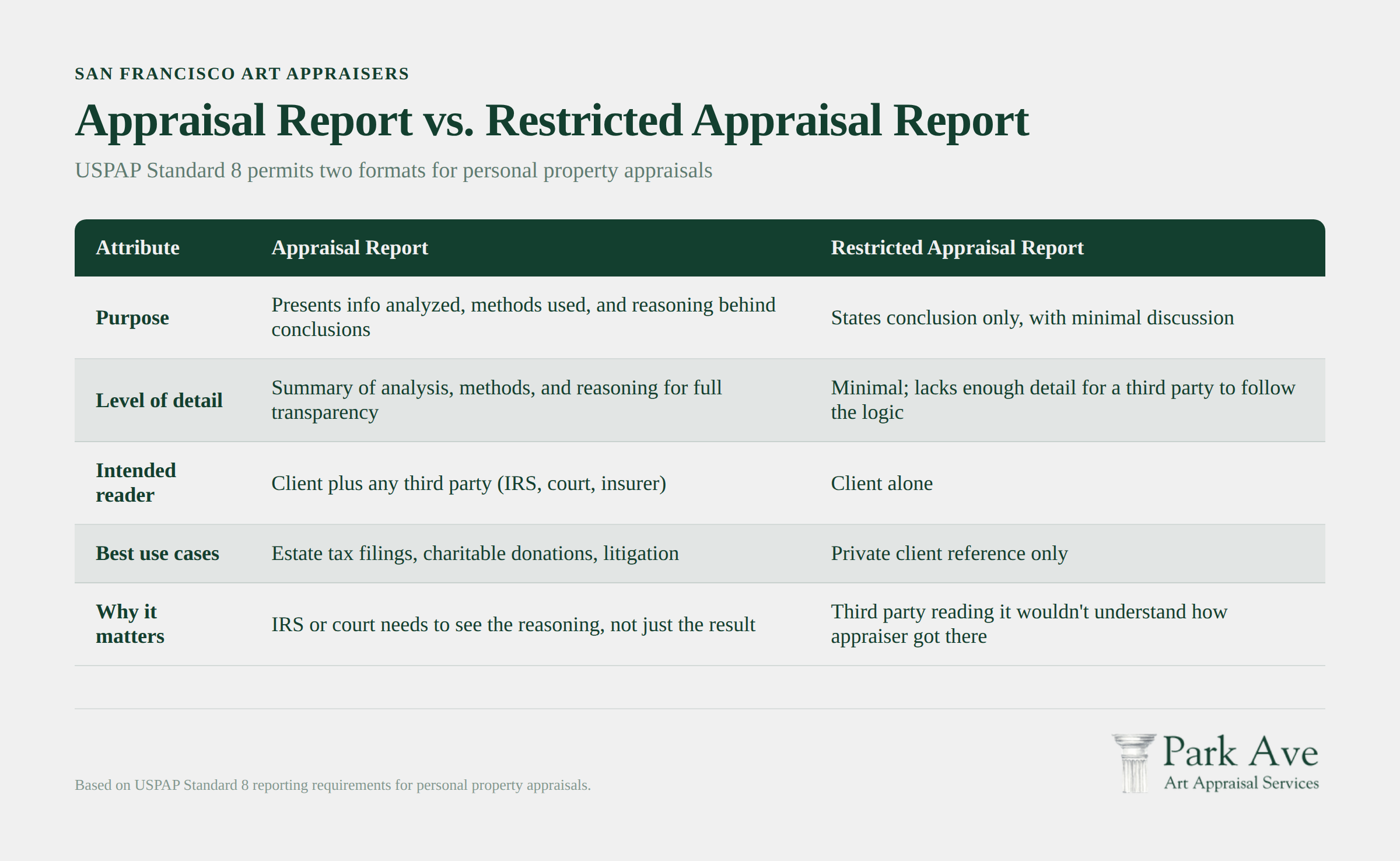
USPAP also permits two different reporting formats for personal property. An Appraisal Report presents a summary of the information analyzed, the appraisal methods used, and the reasoning that supports the conclusions. A Restricted Appraisal Report states the conclusion with minimal discussion and is intended for use by the client alone, since a third party reading it would not have enough information to understand how the appraiser got there. For estate tax filings, charitable donations, and litigation, an Appraisal Report is almost always the right format, because the IRS, a court, or an insurer needs to see the reasoning, not just the result.
Why the IRS Treats USPAP as the Baseline for Art Deductions
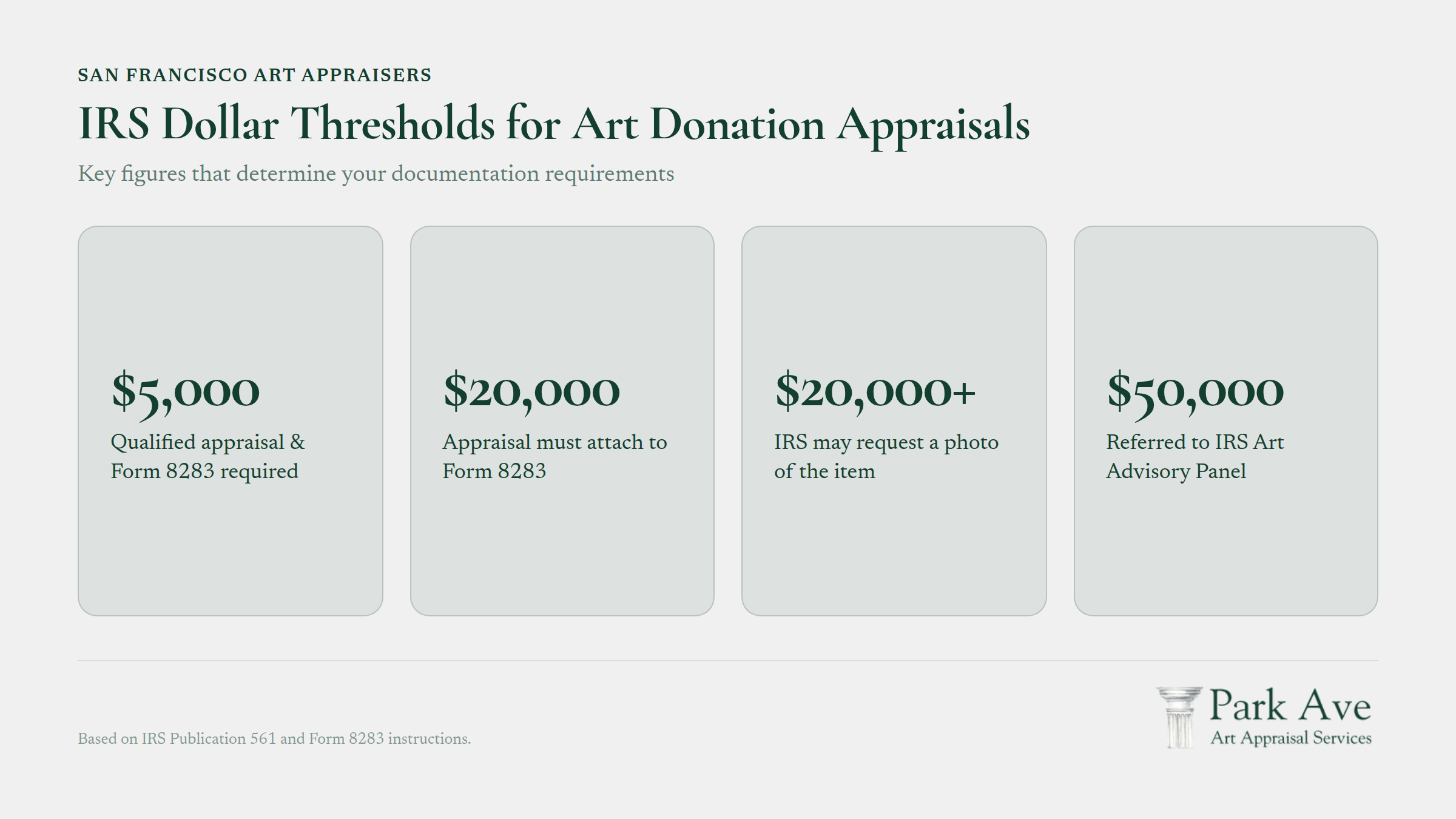
The IRS requires a qualified appraisal for any noncash charitable art donation valued over $5,000, and the appraisal itself must attach to Form 8283 once the claimed value reaches $20,000. These are the two thresholds that decide whether a donor's paperwork holds up.
IRS Publication 561 defines a qualified appraisal as one made by a qualified appraiser and prepared in accordance with the substance and principles of USPAP, along with meeting the timing and content rules in the underlying Treasury regulations. A qualified appraiser, in turn, must have verifiable education and experience valuing the specific type of property involved and must include a declaration of that background in the report itself, which is the same competency standard USPAP already demands.
A few thresholds are worth knowing before a Bay Area donor signs anything:
- Over $5,000: A qualified appraisal and Form 8283 are required to support the deduction.
- $20,000 or more for a single work of art: The qualified appraisal itself must be attached to Form 8283, not just referenced.
- Over $20,000 for an individual item: The IRS can request a photograph of specified size and quality along with the return.
- $50,000 or more: Claims at this level are commonly referred to the IRS Art Advisory Panel for review, which means the appraisal's reasoning and comparables face additional expert scrutiny.
These same thresholds apply whether the donation is going to a local museum or a university, and they're worth understanding before you plan a gift. Bay Area donors weighing where to give and what documentation they'll need can find more on the mechanics of local charitable giving in our guide to donating art in San Francisco.
How San Francisco Courts and Estates Evaluate Appraiser Credibility
Courts, including tax courts handling valuation disputes, routinely evaluate expert witnesses the same way: by looking at whether the appraiser followed a recognized methodology, disclosed the basis for the opinion, and can defend the reasoning under cross-examination. An appraiser who cannot produce supporting data or explain the scope of work performed loses credibility fast, regardless of how confident the final number sounds.
This is where USPAP's Competency Rule and Record Keeping Rule do the real work. The Competency Rule requires the appraiser to have the knowledge and market familiarity needed for the specific type of property, whether that's postwar California abstraction or Chinese classical painting, and to disclose it if they don't. The Record Keeping Rule requires a complete workfile behind every report: the data, the comparables, the inspection notes, and evidence of USPAP compliance, all of which must exist before the report is ever issued.
Pro tip: Ask any appraiser you're considering for a probate, litigation, or high-value donation matter how long they retain their workfiles and what's in them. A qualified appraiser should be able to answer without hesitation, because the retention rule is a fixed professional obligation, not an optional courtesy.
USPAP requires that workfile to be kept for at least five years after the report is prepared, or at least two years after the final disposition of any judicial proceeding in which the appraiser testified about the assignment, whichever period is longer. In an estate dispute or a contested divorce that drags on for years, that retention window is what allows the appraisal to still be defended long after the report was first delivered.
What Insurers Expect Before They Rely on Your Appraisal
Insurers underwriting a fine art policy, or adjusting a claim after a loss, generally want the same things a court wants: a clear methodology, a defined effective date, and enough supporting detail to know the number wasn't pulled from a price guide. A report that states its scope of work, discloses its assumptions, and includes a signed certification gives an insurer a defensible basis for setting coverage limits or settling a claim, which is exactly why USPAP compliance functions as a shared standard across tax, legal, and insurance uses rather than three separate sets of requirements.
Choosing an Appraiser for a Bay Area Estate, Donation, or Litigation Matter
The report format changes depending on the purpose (a Restricted Appraisal Report is fine for a private insurance conversation, but never for a donation or an estate filing), but the underlying discipline should not. Scope of work, assumptions, authentication due diligence, a signed certification, and a retained workfile are the pieces that separate a defensible appraisal from a number on letterhead.
If you're navigating a probate matter, planning a charitable gift, or need a report that will hold up in front of the IRS or opposing counsel, our team can request an art appraisal built to the same standard courts and the IRS already expect.
This article is provided for general informational purposes only and does not constitute legal, tax, or financial advice. Readers should consult a qualified attorney or CPA regarding their specific circumstances.