
Blog
Inherited Art Stepped-Up Basis in California: What San Francisco Heirs Should Know
California levies no state estate or inheritance tax, but heirs of San Francisco art collections still need to document the federal stepped-up basis under IRC Section 1014 before they sell. This guide explains the federal threshold, the fair market value standard, and why a qualified date-of-death appraisal protects a later sale from an IRS challenge.
When someone in San Francisco inherits a painting, a sculpture, or an entire personal collection, the first question is almost always about tax. The good news is simpler than most people expect: California does not tax the inheritance itself. The complicated part is federal, and it centers on a concept called stepped-up basis, which determines how much capital gains tax the heir owes if they ever sell the piece.
This guide walks through California's estate tax position, the federal filing threshold, how stepped-up basis actually works under the tax code, and why heirs planning to sell an inherited piece need a properly documented appraisal before they file. Our art appraisal services prepare exactly this kind of date-of-death and retrospective valuation for estates across the Bay Area.
California Has No State Estate or Inheritance Tax
California has not required a state estate tax return for deaths occurring on or after January 1, 2005. The California State Controller's Office confirms the state's estate tax has effectively been repealed for that period, and San Francisco does not layer any separate city-level estate or inheritance tax on top of that.
That does not mean inherited art is entirely off California's radar, though. The California Franchise Tax Board is clear that while an inheritance itself is not taxable income, any income the inherited property later generates is. For art, the relevant event is usually a sale: if an heir sells an inherited painting for more than their basis in it, that gain is taxable income to California residents, on top of whatever federal tax applies.
So the practical takeaway is this: the location of the art in San Francisco, and the residency of the heir, do not create a California estate tax. They do, however, matter later, when the heir sells and needs to report a capital gain correctly on both federal and state returns.
The Federal Estate Tax Threshold Most Estates Never Reach
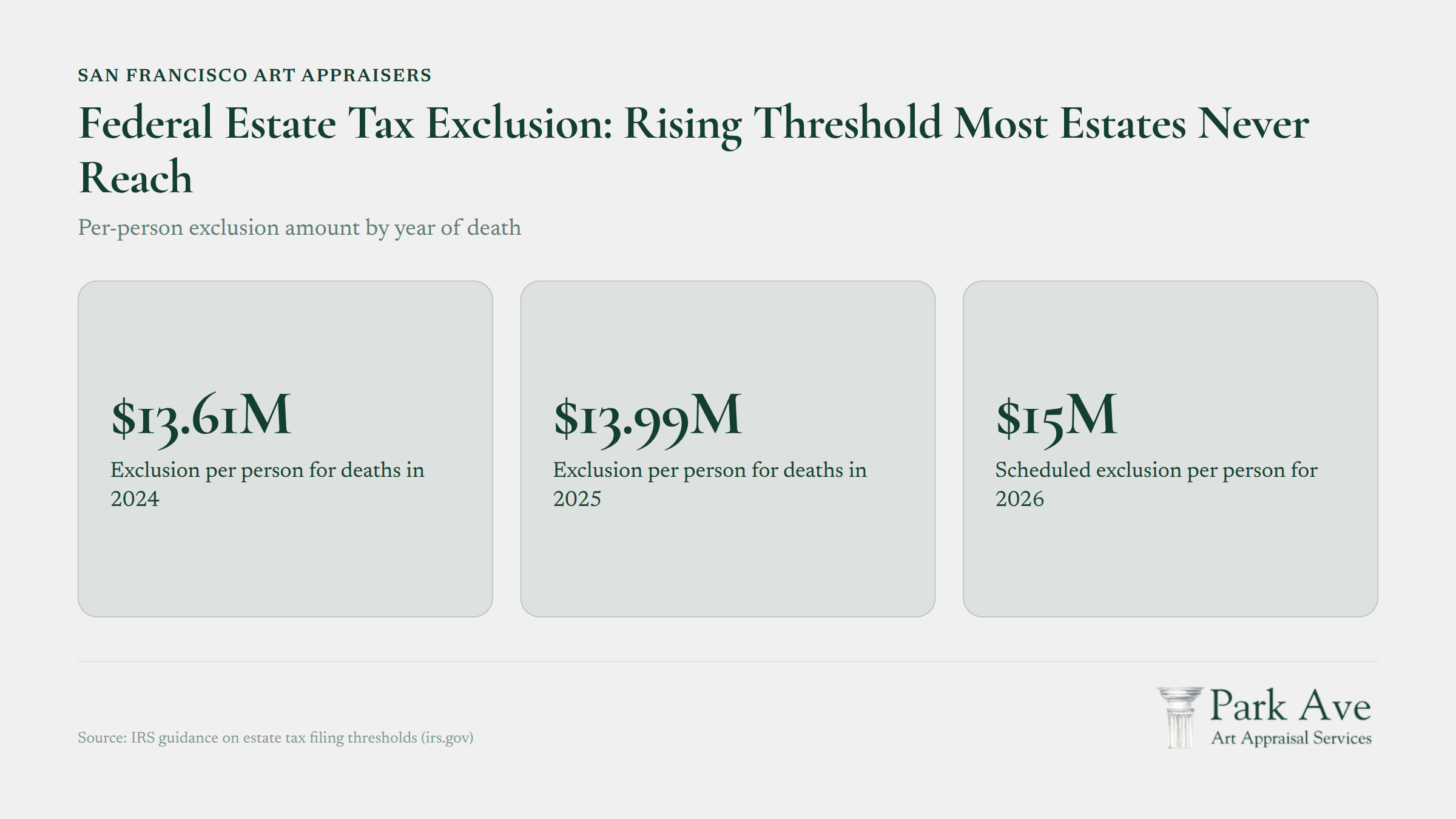
Federal estate tax is the real exposure, but for most families it never actually applies. The exclusion amount is large and adjusts for inflation each year: it was $13.61 million per person for deaths in 2024, and it rose to $13.99 million per person for deaths in 2025, with a further increase to $15 million per person scheduled for 2026, according to IRS guidance on estate tax filing thresholds.
An estate only needs to file Form 706 when the gross estate, combined with certain lifetime taxable gifts, exceeds that threshold. Since most individual estates, even ones that include a valuable art collection, fall well under $13 million to $15 million, most heirs of San Francisco art never deal with an actual federal estate tax bill. The art's value still counts toward the gross estate calculation, which is exactly why an accurate appraisal matters even when no tax is ultimately owed.
Stepped-Up Basis: The Rule That Actually Matters for Heirs
Here is the rule that affects nearly every heir, regardless of estate size: under Internal Revenue Code Section 1014, an heir's basis in inherited property is generally reset to the property's fair market value on the date of the original owner's death, not the amount the original owner paid for it.
This reset is often called a step-up, though it can technically work in either direction. If the art appreciated significantly during the decedent's lifetime, the heir's basis increases (steps up). If the art declined in value, the basis decreases instead. Either way, the decedent's original purchase price generally disappears from the calculation.
The IRS's own guidance on gifts and inheritances confirms that basis is generally the fair market value as of the date of death, and that this applies whether or not the estate was large enough to require a federal estate tax return. A modest estate that owes no estate tax still gets the full benefit of the basis step-up when the heir later sells.
Key takeaway: The step-up happens automatically under the tax code, but proving what the fair market value actually was on the date of death is entirely the heir's responsibility, and that requires documentation, not a guess.
What Counts as Fair Market Value Under the Regulations
Fair market value for estate and basis purposes has a specific legal definition. Treasury Regulation 20.2031-1 defines it as the price at which the property would change hands between a willing buyer and a willing seller, with neither party under any compulsion to buy or sell, and both having reasonable knowledge of the relevant facts.
That standard rules out several numbers people often reach for by default:
- The original purchase price, which reflects a market from years or decades earlier, not the date of death.
- An insurance replacement value, which is typically set higher than fair market value to cover retail replacement cost.
- A single auction estimate, which may not reflect the full range of comparable sales, condition issues, or provenance questions.
- A forced-sale or liquidation price, which the regulation specifically excludes because it does not reflect an unpressured transaction.
For a real appraisal, this means gathering the artist's market history, comparable sales at the right market level, condition and provenance documentation, and, where relevant, the effect of selling the piece individually versus as part of a larger collection. General industry guidance for appraisers treats unusual jumps or drops in value with skepticism unless there's a documented reason, such as the artist's death, a major exhibition, or a record-setting comparable sale, that explains the change.
The Alternate Valuation Date: A Lesser-Known Six-Month Option
Most people assume the date of death is the only valuation date available, but Internal Revenue Code Section 2032 allows an executor to elect an alternate valuation date, six months after death, for the entire estate. If the art (or any other estate asset) is sold, distributed, or otherwise disposed of before that six-month mark, the disposition date is used instead.
This election is not simply an heir's preference for a more favorable number. It's an estate-level election available to the executor, and it only qualifies if it reduces both the gross estate value and the resulting federal estate tax. Because an heir's basis under Section 1014 generally follows whichever valuation date the estate actually used, the alternate valuation election can shift the heir's basis up or down depending on how the art's value moved during those six months.
In practice, this election matters most for larger estates near the filing threshold, where a modest reduction in reported value has a real tax effect. For most San Francisco heirs whose estates fall well under the federal threshold, the standard date-of-death value is what applies, and it's worth confirming with the estate's executor which date was actually used.
Worked Example: How Step-Up Changes the Tax Bill
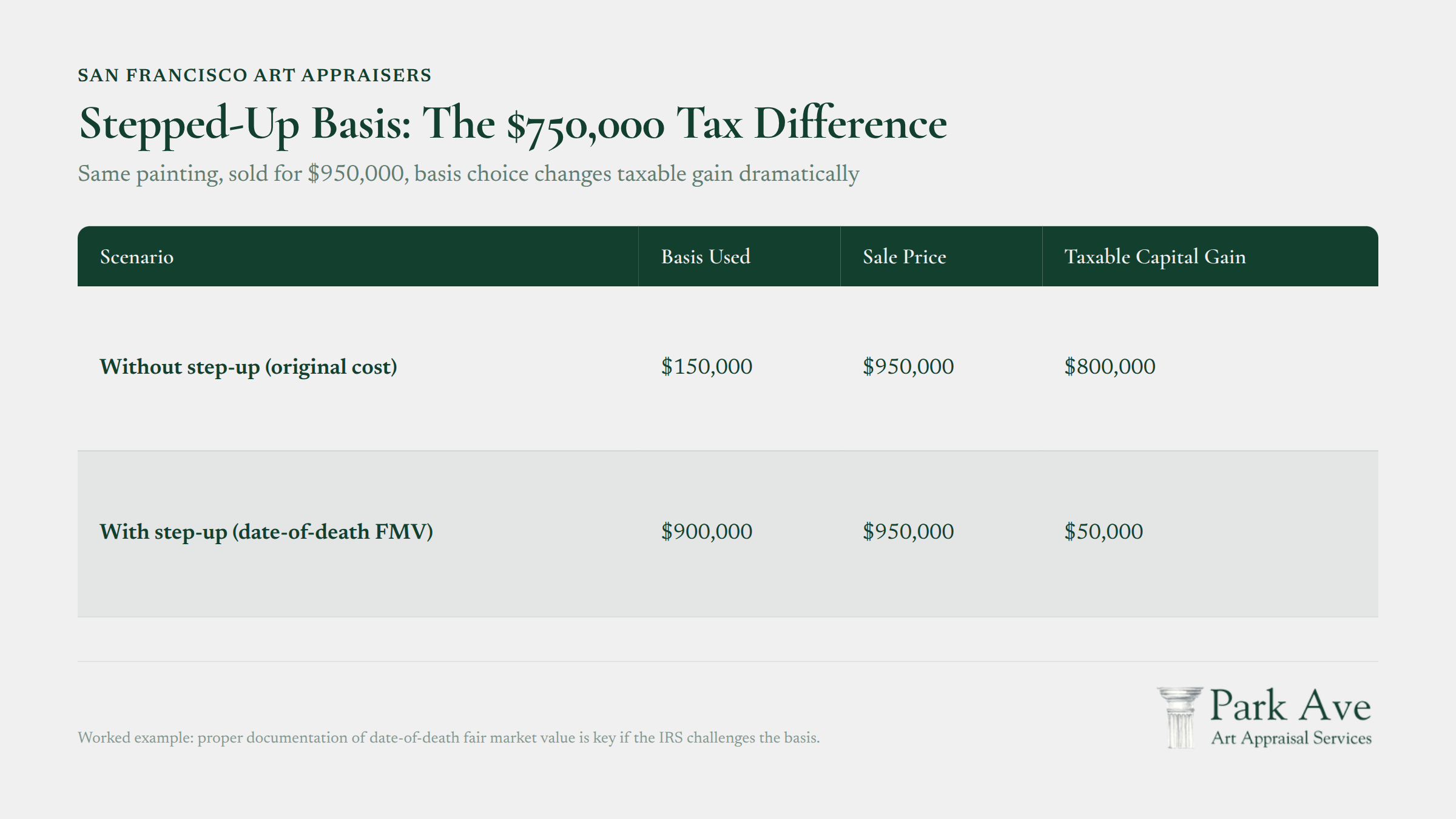
Consider a straightforward scenario. A San Francisco collector purchased a painting decades ago for $150,000. At the time of the collector's death, the piece's documented fair market value, supported by comparable auction results and a formal appraisal, was $900,000. The heir inherits the painting and sells it three years later for $950,000.
| Scenario | Basis Used | Sale Price | Taxable Capital Gain |
|---|---|---|---|
| Without step-up (decedent's original cost) | $150,000 | $950,000 | $800,000 |
| With step-up (date-of-death fair market value) | $900,000 | $950,000 | $50,000 |
The difference is not a rounding error. Without a documented step-up, the heir would be reporting $800,000 of taxable gain on Schedule D and Form 8949. With the step-up properly established at $900,000, the taxable gain drops to $50,000. That $750,000 swing in reportable gain exists purely because of how well (or poorly) the date-of-death value is documented.
Example: If the IRS later questions the reported basis and the heir has no appraisal, only a family recollection of "it was probably worth around $900,000," the agency has grounds to challenge the basis and assess tax, interest, and potentially penalties on the difference.
Why a Qualified Appraisal Matters Even Years After the Date of Death
Heirs often don't think about basis documentation until they're ready to sell, which can be years after the original owner's death. That's a problem, because the burden of proving the stepped-up basis sits with the taxpayer at the time of the sale, not with the estate at the time of death.
A retrospective appraisal, one commissioned after the date of death but valuing the piece as of that historical date, is a recognized and commonly used solution. A qualified appraiser reconstructs the fair market value as of the decedent's date of death using period-appropriate comparable sales, market data from that time, and the same willing buyer, willing seller standard the regulations require. This is standard practice across the appraisal industry precisely because so few families think to commission a valuation at the moment of death.
For higher-value pieces, documentation matters even more. General guidance on IRS estate appraisal requirements describes how the IRS applies closer scrutiny to art valued at $50,000 or more, up to and including referral to internal art specialists during an examination. A single unsupported number on a tax return is a far weaker position than a written appraisal report that documents methodology, comparable sales, and the appraiser's qualifications.
Watch out: Waiting until the year of sale to think about basis is the most common mistake heirs make. The appraisal needed to support a stepped-up basis is best commissioned as soon as possible after the date of death, or as a retrospective valuation before the sale closes, not after the IRS has already asked questions.
We prepare both date-of-death and retrospective appraisals for estates, and our reports are built to withstand exactly this kind of scrutiny. If your family is handling art as part of a San Francisco probate matter, documenting fair market value early keeps the estate's paperwork and the heir's future basis aligned.
Document the Basis Before You Sell
California's lack of a state estate tax simplifies one part of the picture, but it doesn't remove the federal step-up rules, the fair market value standard, or the IRS's documentation expectations. An heir who sells inherited art without a supported date-of-death value is taking on real audit risk for no good reason, especially when the fix, a properly prepared appraisal report, typically costs far less than the tax exposure it protects against.
If you've inherited art in San Francisco and need a date-of-death or retrospective appraisal to establish your stepped-up basis, request an art appraisal and our team will scope the assignment based on the piece, its documentation, and your intended use.
This article is provided for general informational purposes only and does not constitute legal, tax, or financial advice. Readers should consult a qualified attorney or CPA regarding their specific circumstances.