
Blog
Where to Donate Art in San Francisco and the Appraisal Rules You Need to Know
Bay Area museums and university galleries do accept donated art, but none of them can appraise your gift for tax purposes. Here's which San Francisco institutions take donations, how to approach each one, and the IRS appraisal thresholds that determine what your deduction requires.
Donating a painting, sculpture, or collection to a San Francisco museum is a generous act, and it can also produce a meaningful tax deduction. But the process trips up a lot of donors who assume the receiving institution will tell them what the piece is worth. It won't, and it can't. This guide walks through which Bay Area museums and galleries accept art donations, how to start that conversation, and the IRS appraisal rules that kick in once your deduction crosses $5,000, $20,000, or $50,000.
If you're at the point of needing a number for your tax return, our San Francisco art appraisal service prepares USPAP-compliant, IRS-qualified reports built specifically for charitable contribution deductions.
Which San Francisco Museums Accept Art Donations?
Several major Bay Area institutions accept gifts of art, but each has its own intake process, and none will hand you a valuation. Here's an overview of six institutions donors commonly approach.
Asian Art Museum
The Asian Art Museum does not accept unsolicited works dropped off at the door. Donors start by emailing [email protected] with photos of the piece, its provenance, and acquisition history. The museum is explicit on its own donation page that it cannot appraise the art you're offering and directs donors toward independent appraisers instead.
BAMPFA (UC Berkeley Art Museum and Pacific Film Archive)
BAMPFA reviews proposed gifts through its curatorial department and director first, then an acquisitions and collections committee that meets quarterly, and finally the Board of Trustees. Donors email [email protected] with the artist, title, date, medium, dimensions, provenance, and an image of the work. BAMPFA states plainly that donations of $5,000 or more require an independent appraisal before the donor can claim a deduction, and every accepted gift requires a signed deed of gift.
SFMOMA
SFMOMA accepts gifts under a formal Gift Acceptance Policy. A deed of gift or gift agreement has to be signed before the piece is presented to the Board, and collections of 30 or more works receive additional scrutiny. There's no public drop-off window. Individuals should reach out to SFMOMA's development office (its "Ways to Give" contact point) and ask to be connected with the curatorial department that matches the work.
Fine Arts Museums of San Francisco (de Young and Legion of Honor)
The Fine Arts Museums of San Francisco, which operate both the de Young and the Legion of Honor, grow their collections substantially through donor gifts. A recent gifts campaign brought in works from hundreds of donors in a single push. Proposed gifts are reviewed department by department before being recommended to the director and board. As with the other institutions, individuals should contact the development office or the relevant curatorial department directly rather than showing up with the artwork.
Oakland Museum of California (OMCA)
OMCA is explicit: do not bring objects to the museum. Donors submit a proposal through an online donation form describing the object, the artist or maker, the date, the medium, and the provenance. A decision on acceptance follows that review, not the other way around.
University Galleries (Cantor Arts Center and Similar)
Regional university galleries, including Stanford's Cantor Arts Center, generally follow the same pattern as the museums above: curatorial review, then a collections committee vote, then a signed deed of gift. Initial contact goes through the curatorial department or the development office, never a walk-in drop-off.
The thread running through all six is consistent. None of them will appraise the artwork for you, since they're the recipient of the gift and that would be a direct conflict of interest. All of them require a signed deed of gift before the donation is final. And all of them expect you to arrive with documentation already in hand: images, provenance, medium, and dimensions.
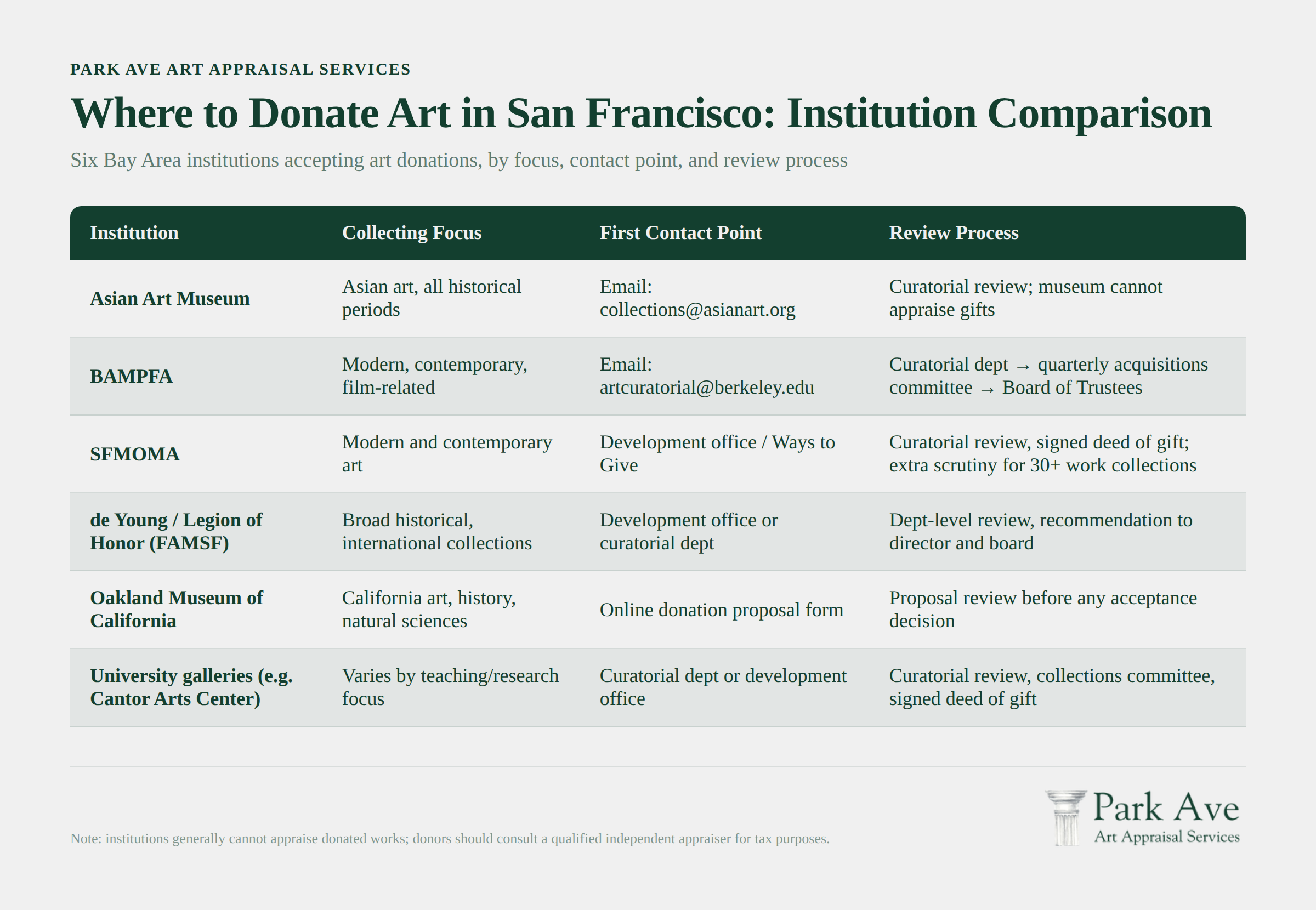
San Francisco Bay Area Art-Donation Institutions at a Glance
| Institution | Collecting Focus | First Contact Point | Review Process |
|---|---|---|---|
| Asian Art Museum | Asian art across historical periods | Email to [email protected] | Curatorial review; museum states it cannot appraise gifts |
| BAMPFA | Modern, contemporary, and film-related works | Email to [email protected] | Curatorial department, then quarterly acquisitions committee, then Board of Trustees |
| SFMOMA | Modern and contemporary art | Development office / Ways to Give | Curatorial review, signed deed of gift, added scrutiny for 30+ work collections |
| de Young / Legion of Honor (FAMSF) | Broad historical and international collections | Development office or relevant curatorial department | Department-level review, recommendation to director and board |
| Oakland Museum of California | California art, history, and natural sciences | Online donation proposal form | Proposal review before any acceptance decision |
| University galleries (e.g. Cantor Arts Center) | Varies by institution's teaching and research focus | Curatorial department or development office | Curatorial review, collections committee, signed deed of gift |
Why Can't the Museum Just Appraise the Gift?
A museum accepting your donation has a direct financial interest in the transaction, since a higher appraised value on your tax return has no bearing on what the museum owns, but the museum is still the recipient of the gift, and the IRS treats that as a conflict of interest by definition. A qualified appraiser has to be independent of the transaction, which rules out the donee organization entirely. That's a formal IRS requirement, not a courtesy policy the museums have invented on their own.
This is exactly why the Asian Art Museum's own donation guidance points donors toward independent appraisers, and why BAMPFA states outright that gifts of $5,000 or more need an outside appraisal. The museum's curatorial staff can confirm a work's attribution and condition for acquisition purposes. They are not positioned to give you the fair market value figure your accountant needs.
Watch out: Don't ask the museum's registrar or curator for an informal value estimate to use on your return. Even a casual number from museum staff carries no weight with the IRS and could actually work against you if it conflicts with your independent appraisal later.
The IRS Dollar Thresholds That Determine What You Need
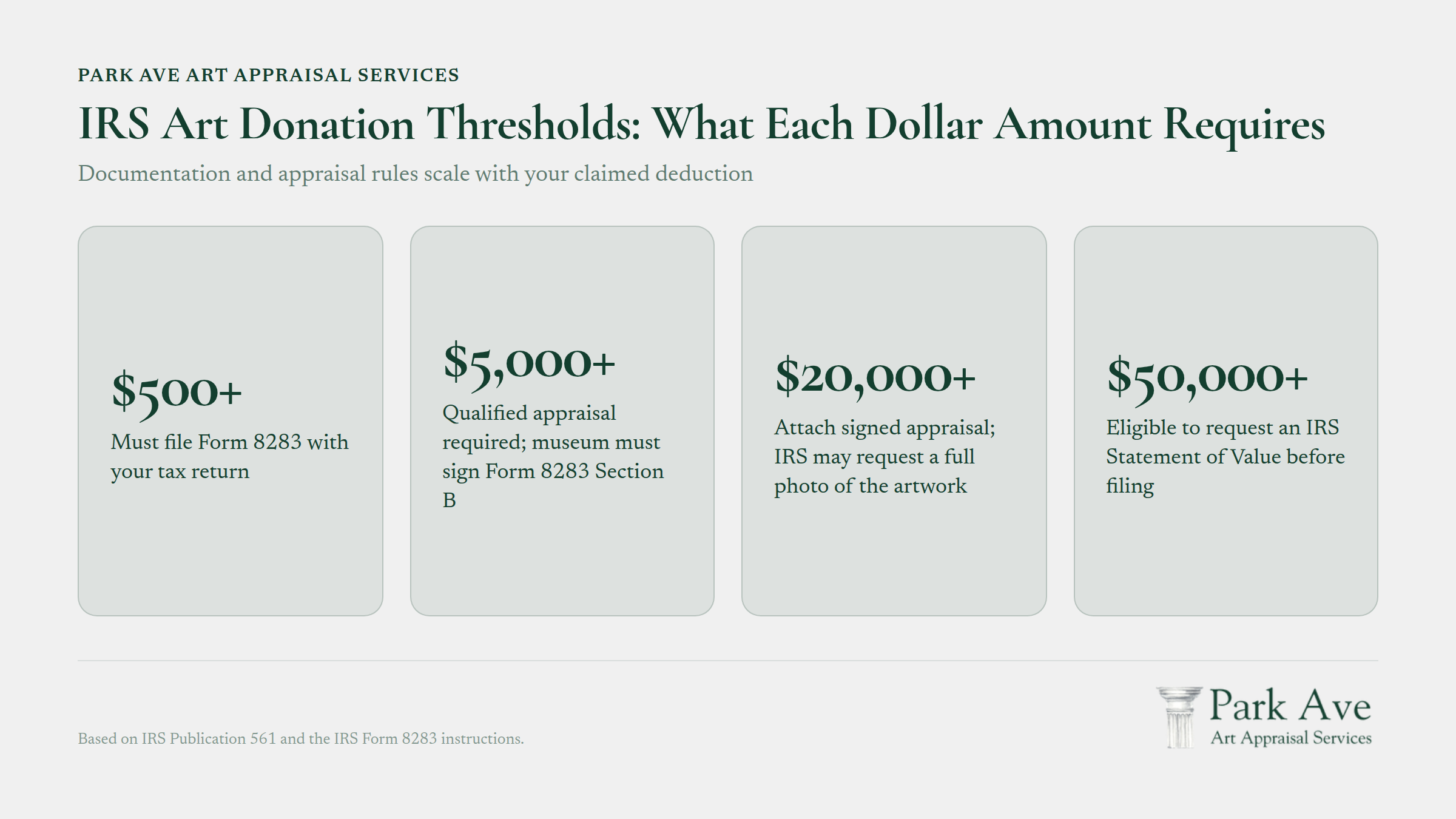
The appraisal and paperwork requirements for a donated artwork scale directly with the deduction amount you're claiming. Three thresholds matter most.
- Over $500: Any noncash charitable contribution above this amount requires filing Form 8283 with your tax return.
- Over $5,000: A donation of art valued above this amount requires a qualified appraisal by a qualified appraiser, and you must complete Section B of Form 8283, which the IRS Form 8283 instructions require the receiving museum to sign as well.
- $20,000 or more: You must attach the complete, signed qualified appraisal to your return, and the IRS may request a photograph of the object on file, ideally an 8x10 color print or high-resolution digital image large enough to show the piece fully.
- $50,000 or more: At this level, you can request an IRS Statement of Value from the IRS Art Appraisal Services division before you file, which gives you advance confirmation of the value the IRS will accept for that specific piece.
The methodology behind these figures, including how fair market value gets determined for art and collectibles, comes from IRS Publication 561. One rule that catches donors off guard: appraiser fees can never be based on a percentage of the appraised value. That structure creates an obvious incentive to inflate the number, so the IRS prohibits it outright, and any appraiser proposing a percentage-based fee should be a red flag.
Pro tip: If you're donating several related pieces (a set of prints, or a small collection to one museum), the IRS aggregates "similar items" toward the $5,000 threshold even if no single piece crosses it alone. Two pieces valued at $3,000 each, donated in the same tax year to the same or different donees, still trigger the appraisal requirement once combined.
When Does the Appraisal Actually Need to Happen?
A common misconception is that the appraisal has to be finished before you hand the artwork over to the museum. It doesn't. The qualified appraisal needs to be completed no later than the due date, including extensions, of the tax return on which you first claim the deduction.
That gives you some breathing room. You can complete the deed of gift with the museum in, say, October, and still have the appraisal finished by the following April (or October, if you file an extension) when your return is actually due. What you can't do is skip the appraisal because the gift transaction already closed. The museum's acceptance and the IRS's appraisal requirement run on separate timelines, and both have to be satisfied for the deduction to hold up.
What a Qualified Appraisal Needs to Cover
A qualified appraisal for donated art has to document more than a single dollar figure. It needs to identify the work, describe its condition and any restoration, address authenticity where relevant, explain the valuation method used, and include the appraiser's qualifications and a signed declaration acknowledging the penalties for a false or fraudulent overstatement of value. For collections, the report also needs to address whether the group is worth more or less as a whole than the sum of its individual pieces.
Given the scrutiny involved, especially for anything approaching $20,000 or the $50,000 Statement of Value threshold, this isn't a report to shop for on price alone. Fees for an IRS-qualified artwork appraisal are quoted as a fixed amount after we scope the assignment (typically starting around $395 for an IRS-qualified report, with the final fee depending on the number of pieces, research required, and documentation needs). If you're still deciding whether the deduction is worth the process, our guide on what it costs to get artwork appraised breaks down how those fees scale with the assignment.
Key takeaway: The museum decides whether to accept your gift. The IRS decides, through your independent qualified appraisal, what that gift is worth for tax purposes. Keeping those two processes separate, and starting the appraisal early enough to hit your filing deadline, is what keeps the deduction defensible.
This article is provided for general informational purposes only and does not constitute legal, tax, or financial advice. Readers should consult a qualified attorney or CPA regarding their specific circumstances.