
Blog
Art Collateral Loans in San Francisco: What Galleries and Collectors Should Know
An art collateral loan in San Francisco depends on a credentialed appraisal the lender can trust, not the borrower's own valuation. This guide explains loan-to-value ratios, liquidation value, SBA collateral rules, and what a lender-ready appraisal package should include.
Fine art has become a recognized form of collateral at private banks and asset-based lenders, and Bay Area gallery owners and collectors are increasingly using their collections to secure financing rather than sell into a soft market. But a bank or lender will not extend credit against a Rothko print or a gallery's inventory without an independent, credentialed appraisal behind it. This guide covers how art-backed lending actually works, what the SBA does and does not offer for art collateral, and what a lender expects to see in the appraisal package before it will move a loan forward.
Our fine art appraisal team prepares the valuations that support these loan applications, and the process starts with understanding how lenders think about collateral risk, not just what a painting might sell for at auction.
How Does Loan-to-Value Work for Fine Art Collateral?
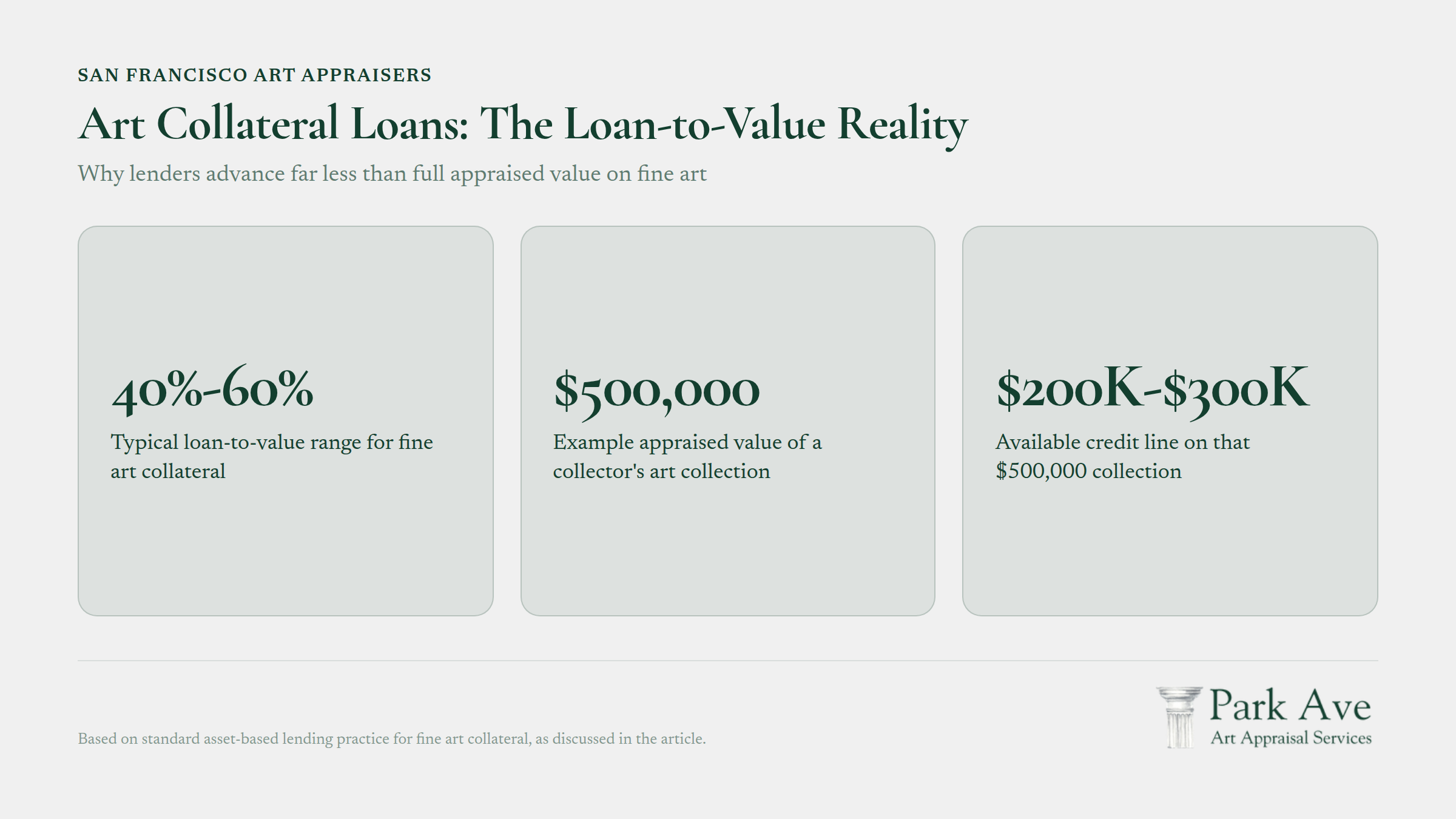
Lenders that accept art as collateral rarely advance anywhere close to full appraised value. As a matter of standard asset-based lending practice, advances against fine art collections commonly fall in a loan-to-value range of roughly 40% to 60% of the appraised value, well below what a lender might advance against real estate or marketable securities.
That conservative ratio exists because art is illiquid, prices can be volatile between named artists and market segments, and a forced sale rarely realizes full retail value. A collector with a $500,000 appraised collection might reasonably expect a credit line in the $200,000 to $300,000 range, not $450,000. Galleries carrying inventory across multiple artists should expect the same discipline applied line by line, not as a blended average across the whole inventory.
Pro tip: If you're building a financing packet, ask your lender upfront what loan-to-value ratio they apply to art collateral before you commission an appraisal. It affects how much of your collection you need appraised to reach the credit line you want.
Why Lenders Require an Independent Appraisal, Not the Borrower's Own Estimate
A lender has no independent way to verify what a borrower says a painting or collection is worth, so it relies on a qualified third-party appraiser instead of the borrower's own opinion of value. This is standard practice across collateral-secured lending against personal property, whether the collateral is fine art, jewelry, or equipment.
The appraiser's role is to stand between the borrower and the lender as an impartial party with no financial stake in the loan outcome. That independence is exactly what a private bank's credit committee is looking for when it reviews a collateral file. A self-prepared estimate, a dealer's informal opinion, or an old insurance schedule will not satisfy that requirement, no matter how well documented it looks.
Liquidation Value vs. Fair Market Value: Why the Distinction Matters
The appraised value a lender uses for collateral purposes is often a liquidation value, meaning what could realistically be recovered in a distress sale, rather than fair market value, which assumes a willing buyer and willing seller under no compulsion to act. Lenders default to liquidation value because it answers the question that actually matters to them: what happens if the borrower defaults and the collection has to be sold quickly?
That distinction can produce a meaningfully lower number than the value a collector might see on an insurance schedule or an estate appraisal. It is not a sign the appraiser undervalued the work. It reflects a different, narrower question being asked of the same asset. Borrowers who expect their loan to be sized against fair market value are often surprised when the bank's number comes in lower, so it is worth clarifying with the lender at the outset which value standard they will apply.
Does the SBA Offer Art-Backed Loans in San Francisco?
No. The SBA does not run a dedicated art-backed loan program, and art collateral is handled the same way any other personal property collateral would be under a lender's standard policy. For SBA loans of $50,000 or less, collateral generally is not required at all except for certain International Trade loans. For loans between $50,001 and $500,000, the individual lender applies its own collateral policy, and SBA guidance on loan collateral makes clear that a loan should not be declined solely because collateral is insufficient.
In practice, this means a San Francisco gallery pursuing an SBA-backed loan should expect the bank, not the SBA itself, to decide whether art inventory qualifies as acceptable collateral and at what advance rate. Some regional and private banks will consider gallery inventory or a named collector's holdings as supplemental collateral alongside receivables or other assets; others will not consider art collateral at all. That variation makes it worth confirming a lender's appetite for art collateral before commissioning an appraisal.
What Belongs in a Lender-Ready Appraisal Package
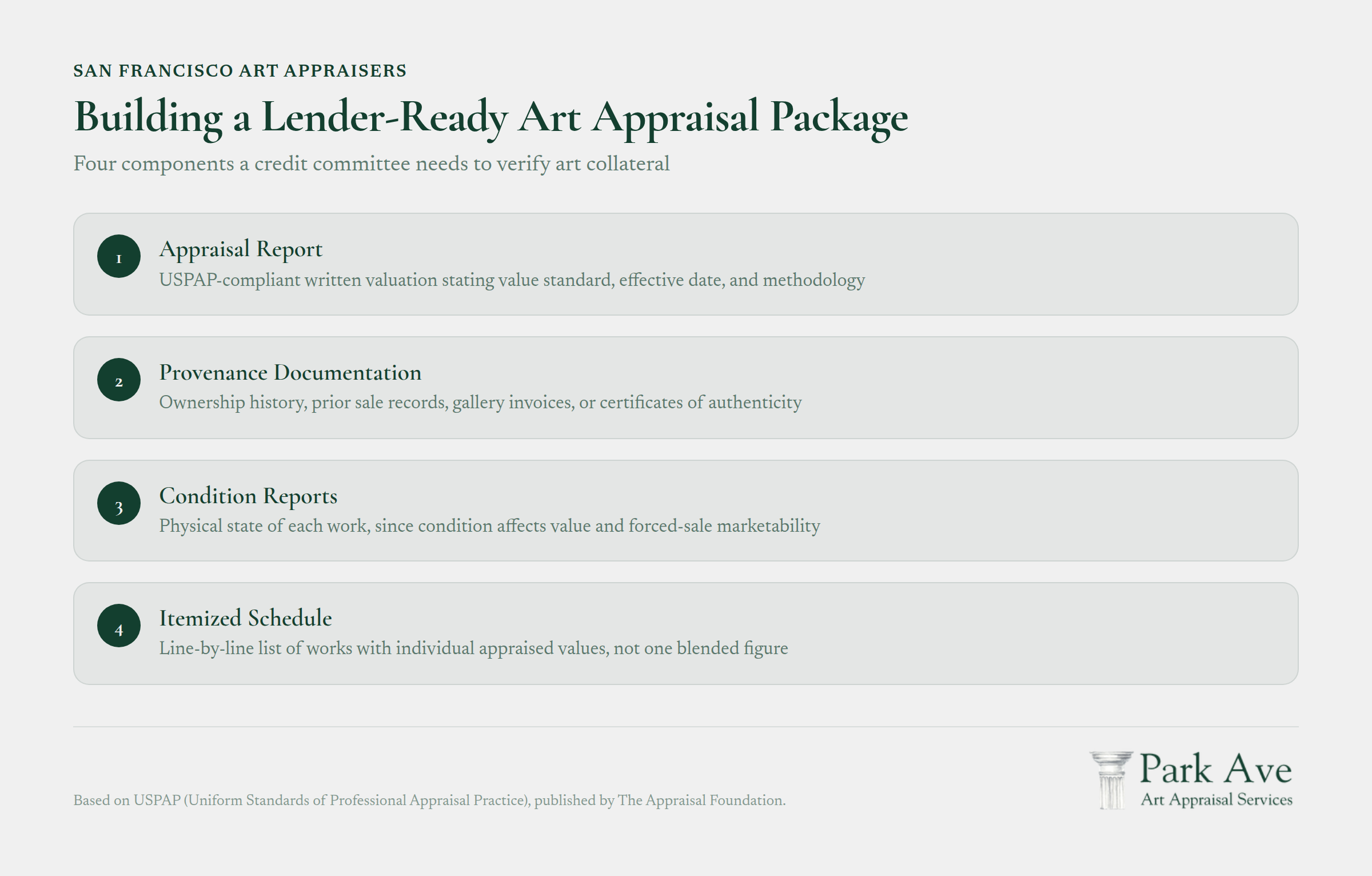
A lender reviewing a collateral file wants more than a number. A complete package typically includes the appraisal report itself along with the supporting documentation that lets a credit committee verify the collateral independently.
- The Appraisal Report
- A written valuation prepared in accordance with USPAP (the Uniform Standards of Professional Appraisal Practice, published by The Appraisal Foundation), stating the value standard used, the effective date, and the methodology applied.
- Provenance Documentation
- Ownership history, prior sale records, gallery invoices, or certificates of authenticity for each significant work.
- Condition Reports
- A description of each work's physical state, since condition materially affects both value and marketability in a forced-sale scenario.
- An Itemized Schedule
- A line-by-line list of works with individual appraised values, not a single blended figure, so the lender can see exactly what secures the loan.
Galleries submitting inventory as collateral should expect the appraiser to work directly from physical inspection wherever possible rather than from a spreadsheet of purchase prices, since purchase price and current appraised value are rarely the same number.
How Often Does Art Collateral Need to Be Reappraised?
Most lenders that accept art as loan collateral require periodic reappraisal, commonly on an annual basis, for as long as the loan remains outstanding. Art markets move, and a value that supported a loan-to-value ratio two years ago may no longer hold, particularly for contemporary or emerging artists whose secondary market can shift quickly.
Watch out: Letting a collateral appraisal lapse can put a borrower in technical default on the loan agreement even when payments are current, since many credit agreements tie the collateral coverage requirement to a current appraisal on file. Building the reappraisal cost and timeline into your annual budget avoids that surprise.
What an Art Collateral Appraisal Costs
Appraisal fees for fine art are quoted as a fixed fee determined during scoping, never billed hourly. For a single work or a small group of pieces, engagements typically start at $295 for a standard report. Full collection or gallery inventory appraisals, which require itemized schedules and more extensive research across multiple artists, typically run from $595 to $2,000, with larger or more complex collections priced higher based on the number of works, the depth of provenance research required, and whether the report needs to meet a specific lender's documentation standard.
Fee is driven entirely by the scope of the engagement, the number of items, and the depth of analysis required, never by the dollar value of the art itself or the terms of the loan.
Preparing Your Collection or Gallery for a Financing Application
A well-prepared appraisal does not guarantee a lender's approval; the bank's own underwriting and credit policy make that call. What our San Francisco fine art appraisers can control is delivering a report prepared in accordance with USPAP, with an itemized schedule, provenance detail, and condition reporting the lender's credit committee can act on without follow-up questions. For collectors and gallery owners weighing whether art-backed financing makes sense, our guide on USPAP compliance and what makes a San Francisco appraisal legally defensible covers the standard in more depth.
If you are exploring a line of credit or an SBA-backed loan secured in part by fine art, start the appraisal conversation early. Lenders move faster on collateral files that already include a complete, standards-compliant report rather than waiting on one after terms are already being negotiated.
This article is provided for general informational purposes only and does not constitute legal, tax, or financial advice. Readers should consult a qualified attorney, CPA, or lender representative regarding their specific circumstances.