
Blog
Art Appraisal in San Francisco Probate: How California Law Values an Estate's Art Collection
San Francisco probate courts require executors to inventory and value estate art within four months of appointment, and Probate Code section 8904 lets you request an independent qualified appraiser instead of the probate referee for unique or valuable pieces. This guide walks through the DE-160/DE-161 filing process, the date-of-death fair market value standard, and when a private fine art appraisal protects the estate.
When someone dies owning artwork, that collection does not simply pass to heirs. It becomes part of the decedent's estate, and California law requires the person managing that estate to identify it, value it, and report it to the court on a strict timeline. If the estate is being administered through San Francisco County Superior Court, understanding how art gets valued in probate matters as much as understanding the art itself.
Our fine art appraisal team regularly works with executors and estate attorneys across San Francisco who are managing this exact process, often for the first time. This guide walks through the inventory rules, the deadline, the probate referee's role, and the option to bring in an independent expert for pieces that deserve closer attention.
The Executor's Duty to Inventory Estate Art
California law places the burden of identifying and reporting estate assets on the personal representative, whether that person is called an executor (named in a will) or an administrator (appointed when there is no will). Artwork is treated the same as any other tangible personal property for this purpose: it must be located, described, and assigned a value as of the date of death.
This duty starts the moment letters testamentary or letters of administration are issued. For a decedent who owned even a modest collection, that means walking through the home, identifying pieces that carry more than decorative value, and separating them from ordinary household goods before the formal inventory is prepared.
Filing the Inventory and Appraisal: Form DE-160 and DE-161
Every California probate estate reports its assets on Judicial Council Form DE-160, Inventory and Appraisal. The form has two parts: Attachment 1 lists assets the personal representative can value directly, such as cash and bank accounts, while Attachment 2, filed on Form DE-161, lists assets that require a third party to establish value. Artwork almost always belongs on the DE-161 attachment.
For each piece, the filing should include enough detail for the value to be verified later: artist or maker, medium, approximate size, and any distinguishing marks or provenance notes. A vague line item like "painting, various" invites questions from the court, from beneficiaries, and potentially from the Franchise Tax Board or IRS if the estate later faces an audit.
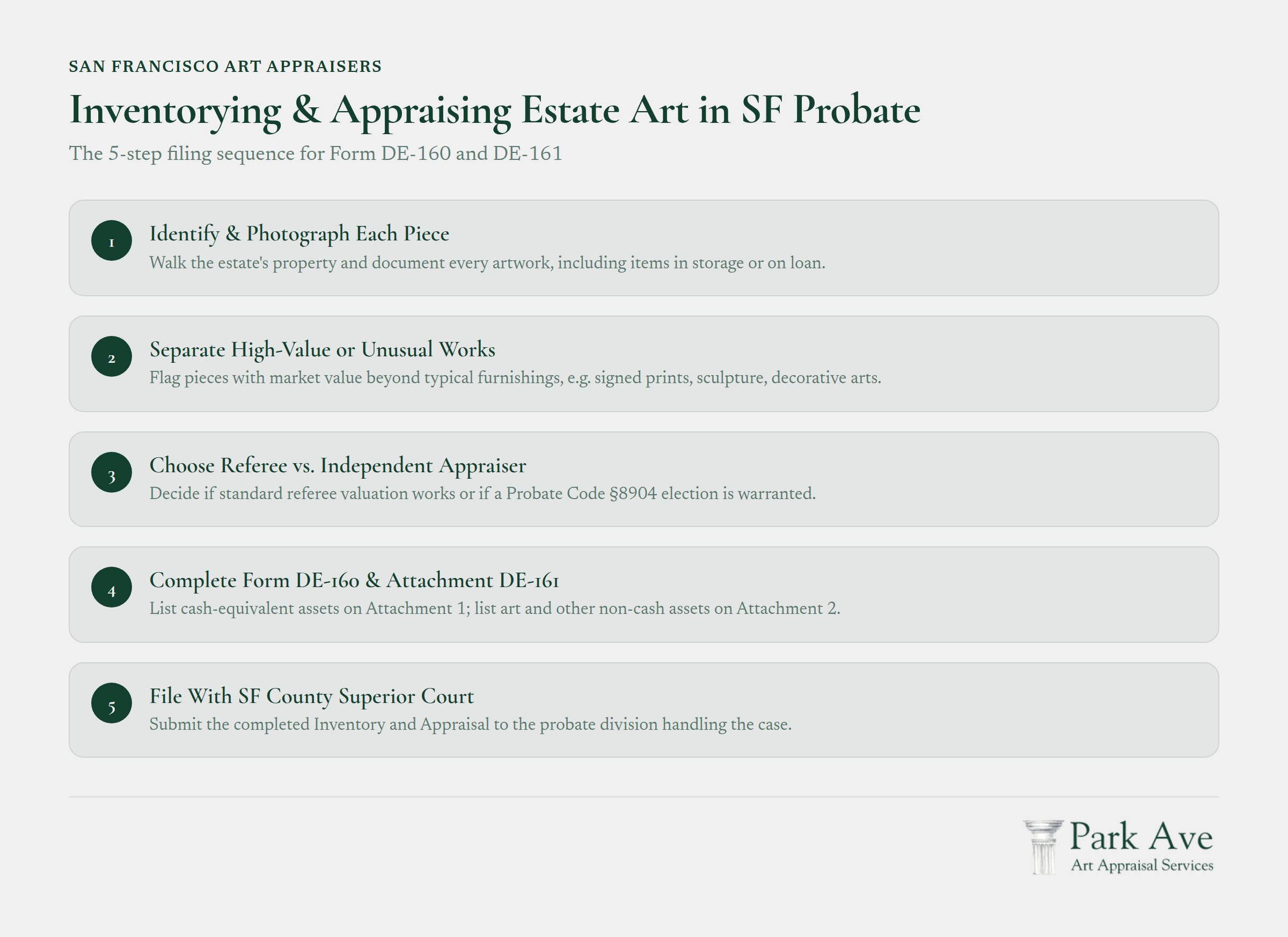
The general filing sequence looks like this:
- Identify and Photograph Each Piece
- Walk the estate's property and document every work of art, including pieces in storage or on loan.
- Separate High-Value or Unusual Works
- Flag anything that appears to have market value beyond typical household furnishings, including signed prints, sculpture, and decorative arts.
- Decide Between the Probate Referee and an Independent Appraiser
- Determine whether standard referee valuation is sufficient or whether a Probate Code section 8904 election is warranted (covered below).
- Complete Form DE-160 and Attachment DE-161
- List cash-equivalent assets on Attachment 1 and non-cash assets, including art, on Attachment 2.
- File With San Francisco County Superior Court
- Submit the completed Inventory and Appraisal to the probate division handling the case.
The Four-Month Deadline Under Probate Code Section 8800
California Probate Code section 8800 gives the personal representative four months from the date letters are first issued to file the Inventory and Appraisal with the court. This is a firm statutory deadline, not a suggestion, and San Francisco County Superior Court's probate division enforces it as part of routine case monitoring.
Missing the deadline does not usually end an administration, but it can trigger a status conference, delay distributions, and draw scrutiny from beneficiaries who are already anxious about timing. For estates with a meaningful art collection, the clock starts running before most executors have even located a qualified appraiser, so identifying valuable pieces early is not optional.
Watch out: Executors sometimes assume the four months starts when the will is admitted to probate. It actually starts when letters are issued, which can be weeks after the initial filing, so confirm the exact date with the court file before counting forward.
How the Probate Referee Values Art
California counties, including San Francisco, use court-appointed probate referees to value estate assets that are not cash or cash equivalents. The referee reviews the DE-161 attachment, applies fair market value as of the date of death, and returns a signed appraisal that becomes part of the official court record.
Probate referees are generalists. They are equipped to value real estate, vehicles, jewelry, and typical household contents efficiently, and for most estates that is exactly what is needed. Artwork is different. A referee handling dozens of estates in a given month is rarely positioned to research an individual artist's auction history, assess condition issues that affect value, or account for a thin secondary market where only a handful of comparable sales exist worldwide.
Date-of-Death Fair Market Value: The Standard That Governs Everything
Every value reported on the Inventory and Appraisal, whether set by the probate referee or an independent appraiser, must reflect fair market value as of the decedent's date of death. Fair market value is the price a willing buyer would pay a willing seller, with neither under compulsion and both having reasonable knowledge of relevant facts, in the appropriate market for that type of asset.
This standard matters because it anchors the valuation to a fixed point in time, regardless of how the art market moves afterward. A painting that gains attention and rises sharply in value two years after the decedent's death is still reported at its date-of-death figure for probate purposes. Getting that number right the first time protects the estate from having to revisit it later during a beneficiary dispute or a tax examination.
The Probate Code Section 8904 Election for Art and Other Unique Property
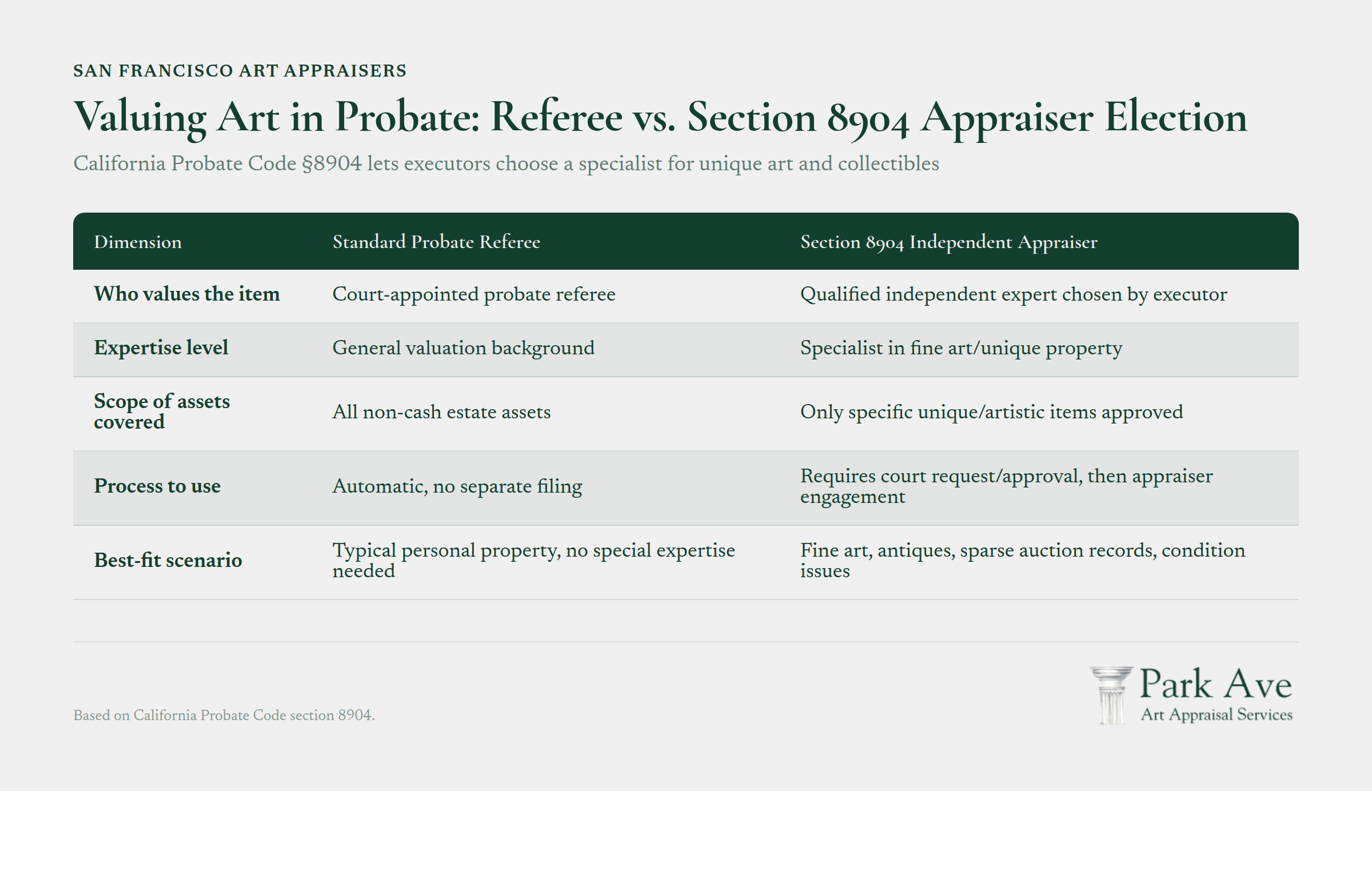
California Probate Code section 8904 allows the personal representative to request that certain property be valued by an independent qualified expert instead of the probate referee. The statute specifically covers tangible personal property that is unique, artistic, unusual, or of a type that a probate referee would not typically have expertise to value, which includes most fine art, antiques, and collectibles of real significance.
To use this election, the personal representative typically files a request with the court (or otherwise obtains court approval, depending on local practice) and then engages a qualified independent appraiser for the specific items in question. The appraiser's report is then submitted in place of the referee's valuation for those pieces, while the referee continues to value the remainder of the estate's non-cash assets.
This matters because it puts the choice of expert in the executor's hands for the assets where expertise actually changes the outcome. A generalist referee and a specialist fine art appraiser working from the same painting can reach very different conclusions, particularly for artists with sparse auction records or works with condition issues that are not obvious from a photograph.
When a Private Fine Art Appraisal Makes Sense
Not every piece in an estate needs an independent appraiser. A decorative print bought at a gallery for a few hundred dollars is well within a probate referee's competence. The calculus changes for certain categories of work, and recognizing them early saves time and prevents disputes later.
Consider a private, independent appraisal when the collection includes any of the following:
- High-value works: Pieces likely worth tens of thousands of dollars or more, where an inaccurate valuation has real tax and distribution consequences.
- Disputed items: Art that beneficiaries disagree about, where an independently credentialed opinion carries more weight in a contested proceeding.
- Thin-market works: Pieces by artists with few recent comparable sales, where establishing fair market value requires research beyond a quick database lookup.
- Historically or culturally significant works: Pieces with provenance questions, attribution uncertainty, or ties to a recognized movement or period.
Our appraisers hold credentials with organizations including the American Society of Appraisers (ASA) and the International Society of Appraisers (ISA), and every report we prepare follows USPAP, the Uniform Standards of Professional Appraisal Practice. That standards framework is explained in more depth in our guide to USPAP-compliant art appraisals in San Francisco, which covers what makes a report defensible if it is ever challenged in court.
For artwork specifically, engagements are quoted as a fixed fee before work begins, never billed hourly. Our published starting fee for artwork appraisal is $295 for a standard report and $395 for an IRS-qualified report, with most engagements falling between $595 and $2,000 depending on the number of pieces and the depth of research required. Museum-quality or extensively documented collections can run from $12,000 to $25,000 or more. Full detail on how those fees are scoped is available on our artwork appraisal cost page.
A Worked Example: Managing a Decedent's Art Collection
Consider an executor appointed to administer a San Francisco estate for a decedent who collected art over four decades. The home contains roughly 30 pieces: a dozen unsigned decorative prints, several pieces of studio pottery, a small bronze sculpture, and one oil painting purchased directly from a mid-century California artist who has since gained regional recognition.
The executor separates the collection into two groups for the DE-161 attachment. The decorative prints, pottery, and household-grade items go to the probate referee for standard valuation, since none carry significant individual value and the referee's generalist approach is appropriate. The oil painting is different: the artist has a documented but limited auction history, and two recent regional sales suggest a value well above what a quick internet search would imply.
The executor files a Probate Code section 8904 request and engages an independent fine art appraiser to value the painting on its own. The resulting report documents the artist's exhibition history, cites comparable sales, and applies the date-of-death standard precisely. That figure, not a referee estimate, goes on the Inventory and Appraisal for that single item, while the referee's values cover everything else. The full DE-160 and DE-161 package is then filed with San Francisco County Superior Court well within the four-month window.
Protecting the Estate Through an Accurate Inventory
Getting art valuation right in probate is not about padding the estate's reported worth or minimizing it. It is about producing a number that will hold up if a beneficiary questions it, if the Franchise Tax Board or IRS asks about it, or if the estate later needs to sell the piece and defend the price it accepts. The four-month filing deadline under Probate Code section 8800 does not leave much room to figure this out as you go, so identifying which pieces deserve an independent expert should happen in the first weeks of administration, not the last.
If you are serving as executor or administrator for a San Francisco estate that includes artwork worth a closer look, our team can scope a fixed-fee appraisal built for the Probate Code section 8904 election and the court's filing requirements. Request an appraisal to get started.
This article is provided for general informational purposes only and does not constitute legal, tax, or financial advice. Readers should consult a qualified attorney or CPA regarding their specific circumstances.